
I often see teams confuse requirements verification and validation. However, both answer different questions. Verification helps me check rules, standards, and quality criteria. Validation helps me check real stakeholder needs. Therefore, I need both activities to find errors early, reduce rework, and create better project results. will operate.
What Are Requirements Verification and Validation?
I use verification and validation to check requirements from two perspectives.
Verification focuses on requirement quality. I check clarity, completeness, consistency, feasibility, traceability, and testability.
Validation focuses on purpose and intent. Therefore, I check whether a requirement represents a real stakeholder need and supports the intended goal.
Requirements verification asks whether I defined the requirement correctly, while requirements validation asks whether I defined the right requirement.
A requirement can pass verification and still fail validation. Likewise, a valid requirement can remain vague or impossible to test. Therefore, I need both activities.
The Difference Between Requirements Verification and Validation
The main difference lies in the reference point.
For verification, I compare a requirement with quality criteria, standards, templates, related requirements, and specification rules.
For validation, I compare it with stakeholder needs, business goals, user goals, processes, and the operating context.
| Aspect | Requirements Verification | Requirements Validation |
|---|---|---|
| Main question | Did I define the requirement correctly? | Did I define the right requirement? |
| Focus | Requirement quality | Requirement intent and relevance |
| Reference | Rules, criteria, standards | Needs, goals, context |
| Typical defects | Ambiguity, gaps, inconsistency | Wrong assumptions, missing needs |
| Main result | A usable requirement | A relevant requirement |
Verification checks conformity, while validation checks suitability.
However, the same method can support both activities. For example, a prototype can expose unclear requirements and incorrect stakeholder assumptions.
Requirements Verification Explained
I use requirements verification to determine whether a requirement meets defined quality expectations.
First, I check whether it communicates one clear need. Then, I look for ambiguity, contradictions, missing information, and hidden assumptions.
I also ask whether developers, testers, architects, and other readers can work with it without unnecessary guessing.
Typical verification questions include:
- Is the requirement clear and unambiguous?
- Is it complete enough for its purpose?
- Does it conflict with another requirement?
- Is it technically and economically feasible?
- Can I trace it to its source?
- Does it follow the required structure?
- Can I define objective acceptance criteria?
- Can I test whether the system satisfies it?
If I cannot explain how to test a requirement, I examine its wording and content again.
Verification therefore improves the internal quality of the requirement before later project activities depend on it.
Requirements Validation Explained
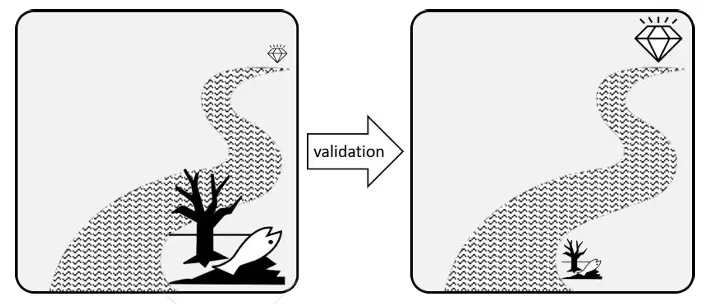
I use requirements validation to determine whether the requirement represents what stakeholders actually need.
Therefore, I look beyond wording and structure. I ask why the requirement exists and what outcome it should support.
Typical validation questions include:
- Does the requirement solve a real problem?
- Does it reflect stakeholder expectations?
- Does it support a business, user, or system goal?
- Does it fit the relevant process and operating environment?
- Does it conflict with another stakeholder need?
- Could it create unwanted effects?
- Do the relevant stakeholders understand its intent?
- Is the requirement still necessary?
A requirement can be perfectly written and still be wrong when it solves the wrong problem.
Validation connects requirements with their reason for existing. As a result, it reduces the risk of developing functionality that looks correct but creates little value.
Why I Need Both Activities
Verification alone cannot tell me whether I selected the right requirement.
For example, a requirement may use precise language, follow the template, and contain measurable acceptance criteria. Nevertheless, stakeholders may not need the specified function.
Validation alone also does not provide enough quality.
A requirement may describe an important need but remain vague, inconsistent, or difficult to test.
Verification protects me from defective requirements. Validation protects me from the wrong requirements.
Together, they reduce errors before those errors spread into design, development, and testing.

Verification and Validation Across the Lifecycle
The terms verification and validation can become confusing because their meaning depends on what I check.
Therefore, I always name the object.
Needs Verification and Validation
I verify stakeholder needs to check whether they are clear and suitable for further analysis.
I validate them by comparing them with their source, stakeholder intention, and relevant context.
Requirements Verification and Validation
I verify requirements against quality criteria, standards, dependencies, and specification rules.
I validate requirements against stakeholder needs, goals, constraints, and intended use.
Design Verification and Validation
Later, I verify whether the design satisfies its input requirements.
I validate whether the design supports the intended solution within the wider system context.
System Verification and Validation
At system level, the focus changes again.
System verification checks whether the implemented system meets its specified requirements and design outputs.
System validation checks whether the system supports its intended use and stakeholder expectations in its operating environment.
Therefore, the familiar system-level questions are:
Verification asks, “Did I build the system right?” Validation asks, “Did I build the right system?”
Production verification can add another check. Here, I confirm that the produced system conforms to the approved design and specification.
This distinction prevents teams from mixing requirements quality with system testing.
Methods for Requirements Verification and Validation
I choose the method according to the uncertainty I want to reduce.
Inspections and Reviews
I use structured reviews to find unclear wording, gaps, contradictions, weak traceability, and poor testability.
In addition, experts from business, architecture, development, and testing can identify problems that one perspective may miss.
Analysis
I analyze feasibility, dependencies, interfaces, constraints, risks, and process effects.
Therefore, analysis helps me expose problems that are not obvious from individual requirements.
Testing
I connect requirements with acceptance criteria and test cases early.
If I cannot define a meaningful test, the requirement may lack precision. Test scenarios can also reveal whether the specified behavior makes sense for real users.
Early test thinking helps me find requirement defects before they become software defects.
Prototypes and Demonstrations
I use prototypes, mockups, and walkthroughs when stakeholders struggle to evaluate abstract requirements.
They make assumptions visible and help me identify missing functions, incorrect expectations, and usability problems.
Models
I use process models, data models, system models, or state models when text alone does not show complex relationships clearly.
Models can expose missing paths, unclear interfaces, contradictions, and overlooked dependencies.
How I Apply Verification and Validation
I do not wait until the requirements specification looks finished.
Instead, I use both activities throughout requirements engineering.
- I identify the stakeholder need and its source.
- I formulate a clear requirement.
- I verify its quality.
- I validate its intent against the stakeholder need and context.
- I resolve gaps, conflicts, and unclear assumptions.
- I connect the requirement with acceptance criteria and tests.
- I repeat the checks after relevant changes.
I treat requirements verification and validation as continuous quality activities, not as one final approval step.
This approach creates a feedback loop. Validation may change a requirement. Therefore, I verify the new version again.
A Simple Example
Suppose I write:
“The system shall display account information quickly.”
The statement may represent a real need. However, I cannot verify it reliably because “quickly” has no measurable meaning.
Therefore, I replace it with a measurable response-time requirement under defined conditions.
Now I can verify its testability.
However, I still need validation. I must ask whether that response time actually supports the user task and whether the same performance is necessary under all conditions.
Verification tells me whether the requirement is measurable. Validation tells me whether I am measuring the right thing.
Common Mistakes I Avoid
I do not use verification and validation as synonyms. Otherwise, I lose the distinction between requirement quality and requirement relevance.
I also do not stop after a formal review. A well-written requirement can still describe the wrong need.
Moreover, I do not treat a simple stakeholder approval as strong validation. Instead, I use concrete questions, scenarios, examples, or prototypes.
I involve the right stakeholders rather than relying only on internal project members.
Finally, I do not check requirements in isolation. Requirements interact with processes, interfaces, constraints, goals, and other requirements.
A requirement can look correct on its own and still create a contradiction within the complete requirement set.
Final Thoughts
Requirements Verification and Validation address two different quality problems.
I use verification to check whether requirements are clear, complete, consistent, feasible, traceable, and testable.
I use validation to determine whether they represent the right stakeholder needs, goals, and intended use.
I also distinguish requirements verification and validation from design and system verification and validation. This prevents confusion across the lifecycle.
Verification helps me define requirements correctly. Validation helps me define the right requirements. I need both before I can rely on a requirement.
As a result, I detect incorrect assumptions earlier, reduce rework, improve communication, and create a stronger basis for design, development, and testing.
What’s Next?
Now that you understand requirements verification and validation, you can go one step deeper. Testing Based Requirement Validation: Catching Defects Early for Success shows how early tests can reveal hidden defects, unclear expectations, and weak acceptance criteria. Therefore, it helps me connect requirements with real quality checks before expensive mistakes occur.
Turn Ideas into Reliable System Results
I use Requirements Engineering to bring structure into complex software projects. First, it helps me discover real stakeholder needs through elicitation. Then, it supports clear documentation, strong validation, and testable requirements. Moreover, it connects requirements management with system analysis, so I can handle change, reduce misunderstandings, and guide better decisions. Read the main article on Requirements Engineering to see how these topics work together and how they help turn ideas into successful systems.
Credits: Photos by Mikhail Nilov and Yan Krukau from Pexels