
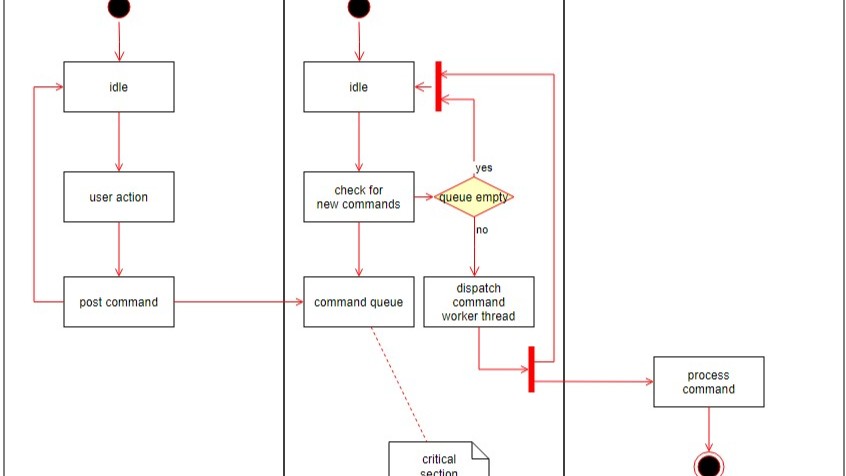
In the world of software development, clear and precise requirements build successful projects. They serve as a blueprint, guiding developers and stakeholders toward a common goal. Traditionally, texts document requirements, but an increasingly popular method is to model these requirements. This article dives into the reasons why modeling requirements can be advantageous, comparing textual and modeled requirements, and discussing the pros and cons of each approach. Learn why to model requirements.
What Is Requirements Modeling?
Requirements modeling means that I represent requirements through structured elements and relationships. I mainly use diagrams to show behavior, decisions, states, dependencies, actors, and interactions.
Depending on the problem, I may use UML, BPMN, SysML, or another suitable modeling approach.
I use requirements models because they make relationships and logic explicit instead of leaving them hidden inside text.
However, I do not replace all textual requirements with diagrams. Instead, I combine both forms.
Why Model Requirements Instead of Using Only Text?
Text works well for simple rules, constraints, and detailed conditions. Moreover, almost every stakeholder can read it without learning a modeling notation.
However, text becomes harder to follow when requirements contain several actions, conditions, alternatives, or dependencies. In that case, the reader must reconstruct the complete logic mentally.
A model makes this structure visible.
The more relationships a requirement contains, the more useful modeling becomes.
Models also force me to make important relationships explicit. I must decide where a process branches, which condition controls a path, or which event causes a state change.
Therefore, modeling does more than visualize requirements. It supports analysis.
Textual and Modeled Requirements Serve Different Purposes
I use text when I need detail. For example, I can describe rules, constraints, exceptions, assumptions, and quality requirements precisely.
I use models when I need structure. They help me show sequences, decisions, dependencies, states, and interactions.
Text can become ambiguous because different readers may interpret the same sentence differently. Models can reduce this ambiguity through a more explicit structure.
However, models also require clear notation and consistent use. A poor diagram can create new misunderstandings.
I use text for detail and context, while I use models for structure, relationships, and logic.
Example: From Textual Requirements to a Model
A simple contact form shows why requirements modeling helps me understand system behavior.
I can start with these textual requirements:
- Req-1: The system must display the contact form.
- Req-2: After the system displays the contact form, the user must be able to enter contact data.
- Req-3: After the user enters the contact data, the next step depends on whether the data is valid.
- Req-4: If the data is valid, the system must store the data.
- Req-5: If the data is not valid, the system must issue an error message.
Each requirement is easy to understand on its own. However, together they describe a flow with different outcomes.
Therefore, I can represent them in an activity diagram.
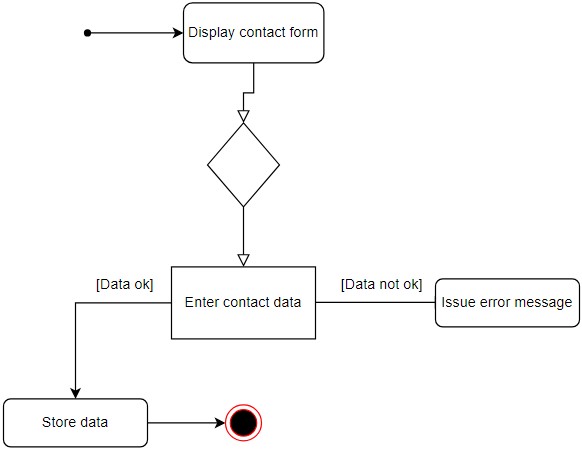
The model shows the sequence directly. First, the system displays the contact form. Next, the user enters the contact data. Then the flow branches.
If the data is valid, the system stores it. If the data is not valid, the system issues an error message.
The text describes the individual requirements, while the model makes their sequence and conditional paths visible.
Models Reveal Hidden Logic and Missing Requirements
Many requirements problems do not exist inside one sentence. Instead, they appear between requirements.
The contact form example shows this clearly. The requirement to store data depends on the condition that the data is valid. The error message belongs to the alternative path.
A model places these relationships next to each other. Therefore, I can inspect the complete logic instead of individual statements.
At the same time, I can identify missing behavior.
The diagram shows what happens after valid data. However, it only shows an error message for invalid data. It does not define what happens afterward.
This raises important questions.
Can the user correct the data? Does the form remain open? Should the system highlight invalid fields? Can the user cancel the process?
The existing requirements do not answer these questions.
One of the strongest reasons why I model requirements is that models expose gaps, contradictions, and hidden assumptions early.
As a result, I can refine requirements before development starts.
Modeling Supports Validation
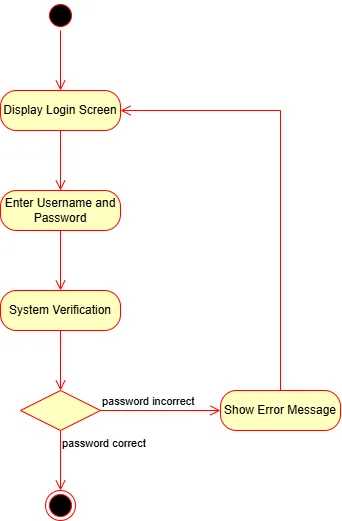
I also use models to validate requirements with stakeholders.
Instead of reviewing isolated sentences, we can walk through a process step by step. We can follow the successful path, inspect alternative paths, and discuss exceptional situations.
For example, I can ask what should happen after invalid contact data. This creates a concrete discussion around an actual process path.
Therefore, models support workshops, reviews, and requirements validation.
A model gives stakeholders a shared representation that they can inspect and challenge together.
This also improves communication between business stakeholders, developers, testers, and architects. Everyone can discuss the same explicit structure instead of relying on different mental interpretations of the text.
Models Help Me Manage Complexity
Large systems contain many different concerns. Therefore, I do not try to show everything in one diagram.
Instead, I separate concerns.
For example, I can use one model for a business process, another for system interactions, and another for state-dependent behavior.
I can also divide complex systems into smaller parts and model each part separately.
This helps me focus on one problem at a time while still keeping the relationships between the different views.
Good requirements modeling reduces complexity by organizing it, not by hiding it.
Models Create Context
Requirements rarely exist in isolation.
One requirement may depend on another. An action may trigger another action. A rule may control a process path. A state may permit or prevent specific behavior.
Text can describe these relationships, but they may be distributed across many sections.
A model brings related elements together.
Therefore, I can see not only what a requirement says but also how it fits into the wider system.
This becomes especially useful when requirements change. I can inspect connected elements and identify possible impacts before I update the specification.
Models Strengthen Requirements Specifications
I often use models as an actual part of the specification rather than as decorative illustrations.
The model can describe the flow. The text can then describe details that do not belong naturally in the diagram.
For example, the contact form model can show that valid data leads to storage and invalid data leads to an error message. Text can then define validation rules, mandatory fields, error messages, or storage constraints.
This avoids unnecessary repetition.
I use the model for relationships and behavior, while I use text for rules, conditions, and additional detail.
However, I must keep both representations consistent. If text and model describe the same behavior differently, I create ambiguity instead of reducing it.
Models Can Support Analysis and Automation
Structured models can also support automated processing.
Depending on the modeling language and tool, I may analyze model properties, examine paths, check state accessibility, generate documentation, or derive input for testing.
For example, control-flow models can help me identify relevant test paths.
However, not every diagram supports automation. An informal drawing may communicate an idea well, but software may not understand its meaning.
The more formally and consistently I define a model, the more opportunities I create for systematic analysis and further processing.
What Are the Disadvantages of Requirements Modeling?
Requirements modeling also creates effort.
First, I need time to create and maintain the models. Second, stakeholders may need to understand the notation. Third, modeling often requires suitable tools.
In addition, an overloaded or poorly structured diagram can become harder to understand than good text.
Therefore, I do not model every requirement.
I model when the additional structure provides clear value.
When Do I Model Requirements?
I mainly model requirements when I need to understand:
- processes and sequences
- decisions and alternative paths
- states and transitions
- interactions
- dependencies
- complex relationships
I also use models when several stakeholders need to establish a shared understanding or when I want to identify gaps and inconsistencies.
In contrast, I usually keep a simple requirement in text if a diagram would add no meaningful information.
I model requirements when the model explains something that text alone would make harder to understand, discuss, or verify.
So, Why Model Requirements?
I model requirements because complex systems contain relationships that text can hide.
Models make these relationships visible. Therefore, they help me understand behavior, detect missing requirements, identify contradictions, validate requirements with stakeholders, and manage complexity.
They also provide context, improve communication, strengthen specifications, and can support analysis, testing, and automation.
However, models do not replace good textual requirements.
Text gives me detail. Models give me structure.
The real value of requirements modeling comes from making the structure of a problem explicit so that I can understand, challenge, and improve the requirements before I build the system.
That is why I model requirements.ul and manageable software development projects.
What’s Next?!
Now that you understand what requirements modeling is and why it matters, it’s time to take your skills further. UML offers powerful tools to make your models more precise and expressive. In my next article, Tips for Requirements Modeling with UML, I share practical advice and easy steps to create effective models that truly support your projects. Click through and discover how to turn theory into practice with UML.
Explore the Full Requirements Modeling Guide
Requirements Modeling helps me turn complex ideas into clear visual structures. In the main article, I explain how Modeling Concepts create the foundation for better understanding. After that, I show how Process Modeling with BPMN helps me describe workflows, responsibilities, and decisions. In addition, I explain how UML supports structure, objects, relationships, and system behavior. Therefore, this guide gives you a clear path from textual requirements to useful diagrams. Click through to the main article on Requirements Modeling and discover how models can improve clarity, communication, and validation in your projects.
This article covers concepts that are also included in the CPRE certification syllabus.