
When I work with SysML, I value its dedicated way of handling textual requirements. Unlike UML, SysML provides a clear notation to express them and introduces a specific diagram type for this purpose. The SysML requirements diagram stands out because it isn’t bound to structural or behavioral views. Instead, it focuses entirely on defining, organizing, and linking requirements. This independence makes it a powerful tool for maintaining traceability and ensuring consistency across complex system models.
Why I Combine Text and Models
Not every requirement works well as a graphical element. Therefore, I combine textual requirements with structural and behavioral models.
Text works especially well for precise statements, limits, conditions, and quality requirements. In contrast, models show relationships, structure, and behavior more effectively.
For example, an activity can show what the system must do. A linked textual requirement can then define a maximum response time.
I use text for precise statements and models for relationships that benefit from visual or structured representation.
This combination prevents me from forcing complex sentences into diagrams.
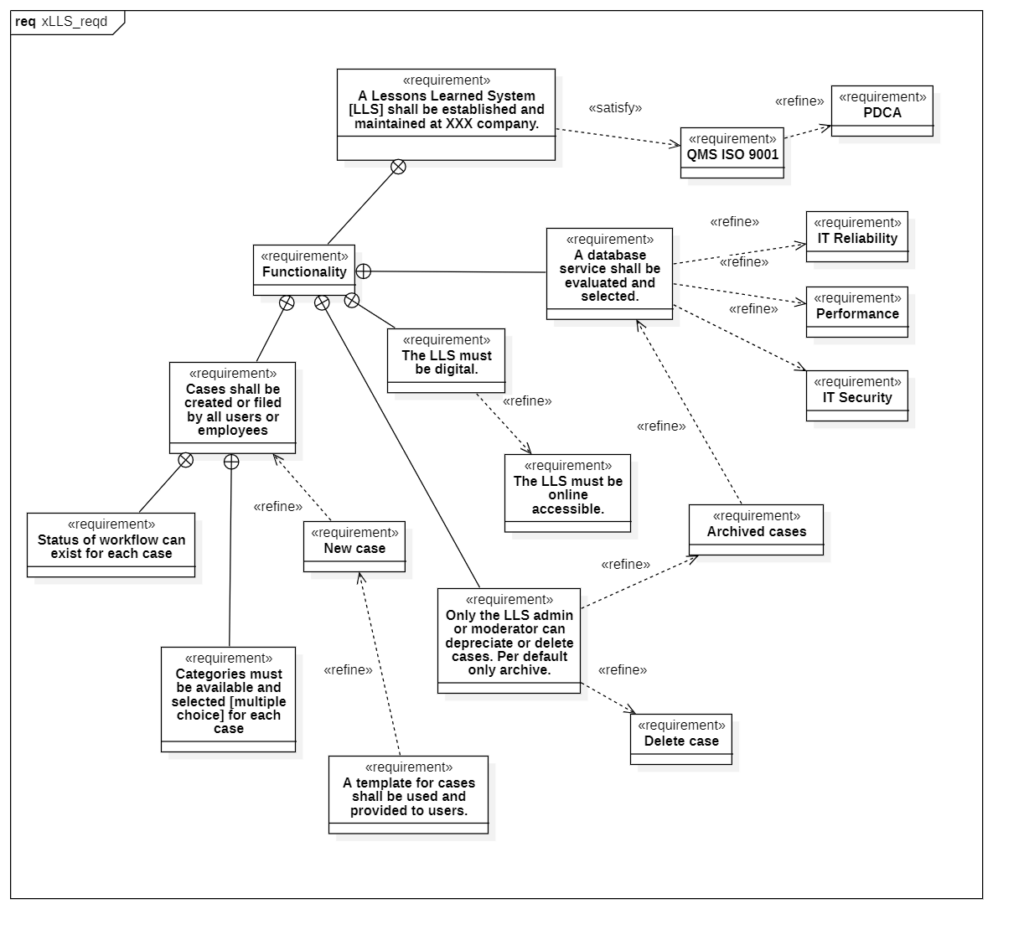
Textual Requirements in SysML v1
SysML v1 introduced explicit support for text-based requirements. Its requirements diagram can show requirements and connect them with other model elements. OMG describes requirements diagrams as a way to represent requirement hierarchies, derivation, satisfaction, and verification.
Therefore, I can connect a requirement to the elements that implement or test it.
For example, I may define a requirement that states that a system must complete an operation within two seconds. I can then connect that requirement to the relevant behavior and to a verification activity.
The important value lies in the relationships, not simply in displaying requirement text inside a diagram.
These relationships give me traceability. They help me understand where a requirement comes from, which system element addresses it, and how I intend to verify it.
Connecting Requirements to Model Elements
I rarely model textual requirements in isolation.
Instead, I connect them to the system context.
For example, I can link requirements to:
- functions and activities,
- system components,
- interfaces,
- behaviors,
- verification activities,
- other requirements.
This creates a connected requirements model.
Suppose an activity represents customer authentication. I may connect a performance requirement that limits processing time. In addition, I may connect a security requirement that defines required protection.
The activity shows the behavior. Meanwhile, the textual requirements define constraints that the activity alone cannot express clearly.
A textual requirement becomes more useful when I can see which parts of the system depend on it.
SysML v2 Changes the Approach
SysML v2 changes how I think about requirements modeling.
SysML v1 centers strongly on graphical modeling and includes the familiar requirements diagram. SysML v2 provides a redesigned language with both graphical and textual notation. OMG formally lists SysML 2.0 as the current generation of the specification.
Therefore, I do not treat the SysML v1 requirements diagram as the universal model for all current SysML work.
In SysML v2, requirements belong more directly to the overall system model. This makes it easier to relate requirements to structure, behavior, analysis, and verification without treating the requirements diagram as a separate documentation world.
The central idea remains the same: I model requirements as connected system information rather than as isolated sentences.
I Avoid Unnecessary Duplication
Combining text and diagrams can also create problems.
If I express the same requirement independently in several places, the representations can diverge. Therefore, I avoid copying the same information unnecessarily.
Instead, I maintain one clear requirement and connect other model elements to it.
For example, I do not repeat the full performance requirement inside several activities. I keep the requirement once and establish the relevant relationships.
This improves consistency. Moreover, it makes changes easier to control.
How I Use Textual Requirements in SysML
My approach is simple.
First, I write a precise requirement when text expresses the information best.
Next, I identify the model elements that provide its context.
Then, I create meaningful relationships between the requirement and those elements.
Finally, I check whether the relationships help me answer practical questions. I want to know what satisfies the requirement, what depends on it, and how I can verify it.
I only add a relationship when it communicates useful engineering information.
This keeps the model readable and prevents traceability from becoming a network of meaningless links.
Conclusion
Integrating textual requirements in SysML allows me to combine the precision of written requirements with the structural power of system models.
In SysML v1, requirements diagrams provide a dedicated way to represent requirements and their relationships. In SysML v2, requirements become part of a more integrated graphical and textual modeling approach.
In both cases, I focus on the same principle.
I connect requirements to the system elements that give them meaning, satisfy them, or verify them.
As a result, I gain better traceability without sacrificing the precision of textual requirements.
What’s Next
Now that you’ve explored how the SysML requirements diagram connects textual and visual elements, it’s time to focus on quality. A model is only as strong as the requirements behind it. But what makes a requirements model truly effective? In my next article, “Understanding the Quality Criteria of Requirements Models,” I’ll explain how to evaluate precision, consistency, and completeness — and why these criteria are vital for building reliable systems.
Learn More Through Requirements Modeling
If I want to understand requirements in a clearer and more structured way, Requirements Modeling gives me the right perspective. In the main article on Requirements Modeling, I explore core Modeling Concepts, Process Modeling with BPMN, and the structural view of UML. Together, these topics help me visualize workflows, describe system relationships, and communicate complex ideas more effectively. Click through to see how Requirements Modeling helps me build a stronger foundation for analysis, design, and better system understanding.
Credits: SysML Requirements Diagram Model by 17387349L8764 from Wikimedia Commons under the license CC BY-SA 4.0 ATTRIBUTION-SHAREALIKE 4.0 INTERNATIONAL
This article covers concepts that are also included in the CPRE certification syllabus.