
As a requirements engineer and IT business analyst, I’ve always been intrigued by tools that simplify complex system management. One framework that truly stands out is SysML, the Systems Modeling Language. In this introduction to SysML, I’ll explain why it’s essential for bridging hardware and software development. I first used SysML on a project combining both domains, and it completely transformed how I handled system complexity, structure, and communication across all stakeholders.
What Is SysML?
SysML is a general-purpose modeling language for systems engineering. I use it to represent different aspects of a system within a coherent model.
For example, I can model:
- requirements,
- system structure,
- behavior,
- interfaces,
- analysis cases,
- verification cases.
SysML therefore supports much of the systems engineering lifecycle. The current SysML v2 specification explicitly covers requirements, structure, behavior, analysis, and verification.
I use SysML when I need to understand not only individual system elements, but also how they relate to each other.
Why I Use SysML
Complex systems rarely consist of software alone. They may combine software, electronics, mechanical components, sensors, networks, people, and external systems.
Textual requirements can describe these elements. However, text often makes their relationships difficult to see.
SysML gives me a structured model instead. Therefore, I can connect requirements with system elements, behaviors, interfaces, and verification activities.
For example, I can model a requirement and then identify which part of the system satisfies it. Likewise, I can connect the requirement with the verification needed to demonstrate compliance.
As a result, SysML supports traceability across the system model.
Structure and Behavior in SysML
I usually examine a system from several perspectives.
First, I need to understand its structure. I want to know which parts exist and how they connect.
Second, I need to understand behavior. I want to know what the system does, how activities interact, and how the system reacts to events.
Finally, I need to connect these perspectives with requirements and verification.
SysML helps me connect requirements, structure, behavior, and verification instead of documenting each perspective in isolation.
This connection is one of its main strengths for complex systems engineering.

SysML and Requirements Engineering
SysML is particularly relevant to me in requirements engineering because requirements can become model elements.
In SysML v1, I can represent textual requirements graphically and connect them through relationships such as satisfy and verify. Requirements diagrams also support requirement hierarchies and derivation.
This allows me to move beyond a list of isolated requirements.
For example, I can connect a performance requirement to the system behavior it constrains. Then, I can connect a verification activity that checks whether the required performance has been achieved.
Therefore, the model provides context around the requirement.
SysML v1 and SysML v2
Today, I distinguish clearly between SysML v1 and SysML v2.
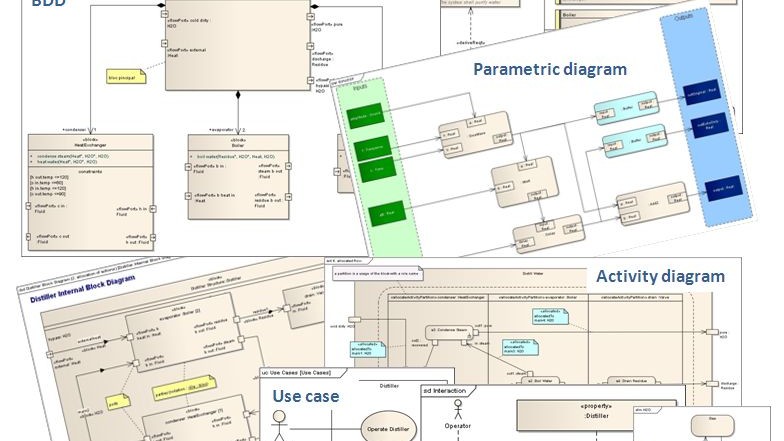
SysML v1 evolved from UML and adapted UML concepts for systems engineering. It uses familiar diagram types such as requirements, block definition, internal block, activity, sequence, state machine, use case, and parametric diagrams.
SysML v2 represents a major redesign. OMG formally adopted SysML v2 in June 2025. It uses the KerML metamodel and provides both graphical and textual syntax.
Therefore, I no longer describe SysML simply as an extension of UML. That description fits SysML v1 much better than SysML v2.
SysML v2 is a new generation of the language rather than merely an updated collection of SysML v1 diagrams.
OMG expects SysML v1 to remain in use for several years while organizations transition to SysML v2.
SysML vs. UML
UML and SysML overlap, but I use them with different priorities.
UML primarily emerged for software modeling. SysML targets systems engineering and therefore addresses multidisciplinary systems more directly.
With SysML, I can treat requirements, physical structures, behavior, analysis, and verification as connected parts of the system model.
This makes SysML especially useful when a system crosses traditional engineering boundaries.
However, I do not choose SysML simply because a project contains hardware. I choose it when an integrated systems model provides value.
SysML and Model-Based Systems Engineering
SysML often supports Model-Based Systems Engineering, or MBSE.
In an MBSE approach, I use structured system models as an important source of engineering information. Therefore, I do not treat diagrams only as illustrations for documents.
Instead, model elements have defined relationships and meaning.
SysML v2 strengthens this approach through more precise semantics, graphical and textual notation, and standardized model access.
That makes the model more suitable for automation and integration with other engineering activities.
When I Use SysML
I consider SysML when I need to manage several connected system perspectives.
For example, it becomes useful when I need to:
- connect requirements with system architecture,
- model multidisciplinary systems,
- analyze complex interactions,
- maintain traceability,
- relate requirements to verification,
- understand dependencies across system elements.
However, I do not use SysML simply because a system is complicated.
A small process problem may be easier to express with BPMN. Likewise, a focused software design may fit UML better.
I choose SysML when integrated systems modeling solves a real engineering problem.
Conclusion
SysML gives me a structured language for modeling complex systems. I can use it to connect requirements, structure, behavior, analysis, and verification.
SysML v1 established many of the graphical concepts that engineers still use today. However, SysML v2 modernizes the language with a new foundation and both graphical and textual syntax.
For requirements engineering, the main benefit remains clear.
SysML helps me turn separate requirements and engineering views into a connected model of the system.
What’s Next?!
Now that you’ve read this introduction to SysML, you’ve seen how powerful modeling languages can simplify complex systems. But SysML is just the beginning. Visual modeling brings clarity not only to system design but also to communication and collaboration. Curious why I rely so much on diagrams in my daily work? Continue with my next article, “The Benefits of Requirements Modeling: Why I Swear by Diagrams,” and discover how visual thinking turns complexity into clarity.
Discover the Power of Requirements Modeling
If I want to turn complex requirements into something clearer and easier to manage, Requirements Modeling gives me the right approach. In the main article on Requirements Modeling, I explore essential Modeling Concepts, Process Modeling with BPMN, and the structural perspective of UML. Together, these topics help me visualize processes, understand relationships, and communicate system needs more effectively. Click through to see how Requirements Modeling helps me create clarity, improve analysis, and support better system design.
This article covers concepts that are also included in the CPRE certification syllabus.
Credits: SysML Collage from Wikimedia Commons