
Adapting and extending a modeling language is essential for precise requirements modeling. UML and SysML provide flexible mechanisms to customize modeling elements. This adaptability allows project-specific or domain-specific concepts to be seamlessly integrated into existing notations. By doing so, models stay both accurate and relevant to real-world systems. To understand this powerful capability, explore how stereotypes in UML and SysML enable tailored extensions for clearer, more meaningful representations.
What is Requirements Modeling
I use requirements modeling to represent requirements in a structured and visual form. Models help me describe system structures, behavior, relationships, processes, and boundaries. Therefore, they complement textual requirements and make complex information easier to discuss.
UML and SysML provide standardized modeling concepts for this purpose. However, a standard language cannot contain every concept that matters in every organization or technical domain.
Requirements modeling becomes more useful when the notation expresses the meaning that stakeholders actually need.
Stereotypes give me one way to add this project-specific meaning.
Why Adapt UML and SysML?
Standard UML elements already have defined semantics. Nevertheless, I may need to distinguish elements that play different roles in my project.
For example, several elements may technically be classes. However, one class may represent a business concept, another an external system, and another a domain entity. I can use stereotypes to make these differences explicit.
Therefore, I do not change the basic UML element. Instead, I add a more specific classification.
A stereotype adds project-specific or domain-specific meaning while preserving the underlying modeling concept.
One distinction is important today. This article describes the stereotype mechanism of UML and UML-based SysML v1. SysML v2 follows a different approach. It uses metadata and model libraries instead of the SysML v1 concepts of stereotypes and profiles.
How Stereotypes Work
When I define a stereotype in UML or SysML v1, I specify which modeling concept it extends and what additional meaning it introduces.
I consider two aspects:
Syntactic Part
First, I define how I identify the stereotype in the model. I also determine which type of modeling element may use it.
For example, I can define a stereotype called «domain» for selected classes.
Semantic Part
Second, I define what the stereotype means.
For example, «domain» could indicate that a class represents a concept from the business or application domain rather than a technical implementation element.
This definition matters. Otherwise, a stereotype becomes only a visual label.
I use stereotypes to communicate defined semantics, not simply to decorate diagrams.
Modeling Diagrams
In UML diagrams, I commonly display a stereotype name between guillemets, such as «domain». UML supports stereotypes as part of its profile mechanism.
For example, I may model the classes Customer, Contract, and Invoice. If these classes describe concepts from the application domain, I can mark them with «domain».
As a result, readers immediately receive additional information about their role.
However, I use stereotypes selectively. Too many custom labels can make a model harder to understand. Therefore, each stereotype should have a clear purpose and a consistent definition.
Class Diagram with a <<domain>> Stereotype
In a class diagram, I can use «domain» to separate domain concepts from technical or implementation-oriented classes.
For example, Customer may represent a business concept, while DatabaseAdapter represents a technical component. Although both elements may appear in related models, they serve very different purposes.
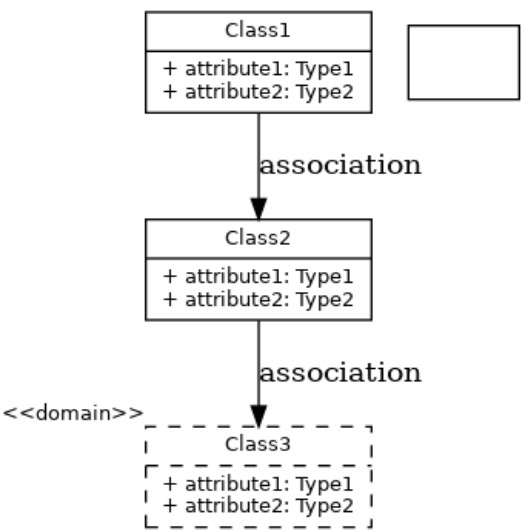
The stereotype makes this distinction visible without requiring a long explanation in the diagram.
A well-defined stereotype can communicate important modeling context with very little additional notation.
Practical Example
Suppose I model a healthcare system.
The model contains Patient, Treatment, Appointment, and Invoice. These concepts belong to the healthcare or business domain. Therefore, I could classify them with a defined domain stereotype.
At the same time, the model may contain technical elements such as AuthenticationService or ExternalAPI. I would not apply the same stereotype to them if they represent a different modeling concern.
As a result, readers can distinguish domain concepts from technical elements more quickly.
However, I would first define what the stereotype means and where I may apply it. This keeps the model consistent.
The same principle applies to other domains. For example, I can use clearly defined stereotypes to distinguish regulatory concepts, external systems, legacy elements, security-relevant elements, or other project-specific categories.
Conclusion
Stereotypes help me adapt UML and SysML v1 models when standard modeling elements do not express enough project-specific meaning.
I first define the additional concept. Then I specify where the stereotype applies and what it means. Finally, I use it consistently throughout the model.
This approach can improve clarity without creating an entirely new modeling language.
The value of a stereotype comes from its defined meaning and consistent use, not from the label itself.
Therefore, I use stereotypes only when they make a model easier to interpret and support better communication about requirements.
What’s next?!
Now that you know how requirements modeling shapes successful projects, it’s time to explore how context adds clarity. Every system exists within a larger environment, and understanding that environment is key to defining its boundaries and interfaces. Curious to see how it all connects? Continue your journey with my next article, The Context Diagram, and discover how visualizing system surroundings creates a solid foundation for accurate and complete requirements.
If I also want to improve the way I present my models, I can continue with 4 Practical Tips for UML Modeling – Making Your Diagrams Speak for Themselves. This article shows me how to create clearer diagrams that communicate ideas faster and support better discussions.
See How Requirements Modeling Creates Clarity
If I want to understand requirements in a deeper and more visual way, I need more than text alone. I need models that show how ideas, processes, and structures connect. In the main article on Requirements Modeling, I explore core Modeling Concepts, Process Modeling with BPMN, and the structural perspective of UML. Together, these topics help me analyze requirements more clearly, communicate them more effectively, and build a stronger foundation for successful system design.
This article covers concepts that are also included in the CPRE certification syllabus.