
In my experience as a tech blogger, modeling relationships in UML can seem intimidating. But here’s the truth: it doesn’t have to be complicated. In this blog, I’ll break down how simple UML modeling relationships work, share some examples, and help you understand why they are crucial. You’ll see how simple it is to get started. So, let’s dive in!
What Is a Binary Association?
A binary association connects two classes.
For example, I can connect Person and Address. However, one pair of classes can have more than one meaningful relationship.
A Person may live at an Address. In addition, a Person may use an Address as a correspondence address.
An association expresses a specific relationship between instances of the connected classes.
Describing the Relationship
I add information to an association when I need to make its meaning precise.
For example, I can use:
- an association name such as lives at,
- a reading direction,
- multiplicities at the ends of the association.
The name explains the meaning of the relationship. Meanwhile, the reading direction tells me how to read it.
Multiplicity adds an important rule. It defines how many objects can participate in the relationship.
In the example, each Person has one Address for each modeled relationship. However, one Address can relate to several Person objects.
Multiplicity turns a simple connection into a precise statement about the permitted relationships between objects.

From Classes to Concrete Objects
The class diagram defines the general relationships. However, I can also look at concrete objects to understand how those rules apply.
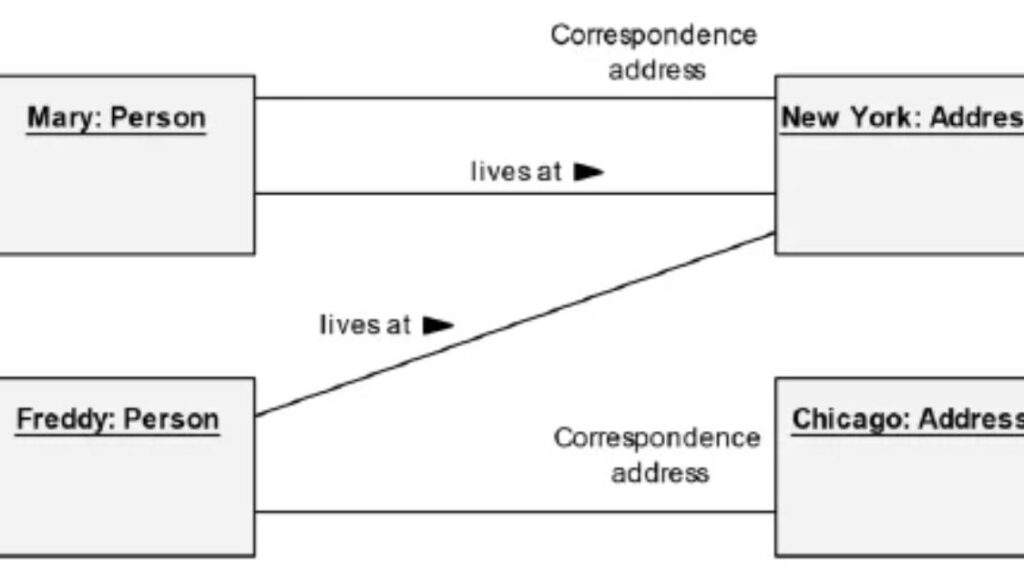
For example, Mary and Freddy are objects of Person. New York and Chicago are objects of Address.
Mary lives at New York. Freddy also lives at New York. However, Freddy uses Chicago as a correspondence address.
This object-level view makes the general class relationships easier to verify.
The class model defines which relationships are possible, while concrete objects show actual examples of those relationships.

Why Associations Matter in Requirements Modeling
Associations give requirements additional context.
For example, “show address” remains unclear because it does not identify which address matters.
In contrast, “show the correspondence address of the person” refers to a specific relationship in the information model.
Therefore, associations help me make requirements more precise.
They also help me check consistency. If a requirement assumes a relationship that the model does not allow, I need to clarify either the requirement or the model.
Associations help me express which objects relate, how they relate, and how many relationships the model permits.
Conclusion
I use simple UML relationships to connect concepts in an information model.
A binary association connects two classes. Its name explains the relationship, while its reading direction and multiplicities make the meaning more precise.
The Person and Address example shows this at two levels. First, the class diagram defines the general relationships. Then, the object example shows how Mary, Freddy, New York, and Chicago participate in them.
A well-defined UML association turns a simple line between classes into an explicit domain rule.
What’s Next?!
Now that you understand the fundamentals of Simple UML Modeling Relationships, it’s time to explore the building blocks behind them. In my next article, “UML Data Types: Simplifying Complex Concepts,” I’ll break down how different data types bring structure and clarity to your models. Join me to learn how mastering UML data types helps you represent complex information in a simple, precise, and effective way.
Continue with Requirements Modeling
If I want to understand requirements beyond written statements, I need models that make ideas easier to see and discuss. In the main article on Requirements Modeling, I explore essential Modeling Concepts, Process Modeling with BPMN, and the structural perspective of UML. Together, these topics help me visualize workflows, describe relationships, and analyze systems more clearly. Click through to see how Requirements Modeling helps me turn complex requirements into structured, practical, and easier-to-communicate models.
This article covers concepts that are also included in the CPRE certification syllabus.