
Today, object-oriented thinking defines how we design systems and build software. I use it every day and see its importance growing. From Java to C++, this mindset shapes how modern applications work. But object-oriented thinking goes far beyond coding—it changes how we analyze problems and model real-world scenarios. In this article, I’ll explain what object-oriented thinking really means, why it matters, and how it helps create smarter, more adaptable systems.
What Is Object-Oriented Thinking?
I use object-oriented thinking to break a complex system into understandable parts. However, I do not simply convert every noun into an object. Instead, I identify concepts that have a meaningful role in the system.
An object usually combines three aspects:
- Identity: I can distinguish it from other objects.
- State: It holds information that can change.
- Behavior: It performs or supports meaningful actions.
For example, I can model a customer account as an object. It has an identity. It holds information such as its status and balance. Moreover, it supports behavior such as recording transactions or checking whether an operation is allowed.
Object-oriented thinking therefore connects data and behavior instead of treating them as unrelated parts of a system.
I also distinguish objects from classes. An object represents a specific instance. A class describes the common structure and behavior of similar objects. For example, Member can define a type, while a specific library member represents an object of that type.
I Model the Domain Before I Model the Software
Object-oriented thinking does not start with Java, C#, Python, or another programming language. I start with the problem domain.
First, I ask what the system must accomplish. Then, I identify the important concepts. After that, I define their responsibilities and relationships. Only later do I decide how software should implement them.
This distinction matters. Otherwise, technical decisions can distort the analysis too early.
I use object orientation first as a method for understanding a domain and only later as a method for implementing software.
For example, when I analyze a library, I might identify Member, Book, BookCopy, Loan, and Reservation. These concepts exist because they explain how the library works. They do not exist because a programming language requires them.
At the same time, I simplify reality. I do not try to reproduce every detail of the real world.
A useful object model represents the parts of reality that matter for the purpose of the system.
Responsibilities Matter More Than Objects Alone
Finding objects is only the beginning. Next, I ask what each object should know and what it should do.
Consider a Loan. It can connect a Member with a BookCopy. It can record when the loan started and when the item is due. Moreover, it can determine whether the loan is overdue.
This responsibility belongs naturally to the Loan because the required information already belongs there.
Therefore, I try to keep related information and behavior together. This principle supports encapsulation. It also prevents responsibilities from spreading randomly across the system.
However, I avoid turning objects into isolated containers of data. An object-oriented model becomes much stronger when objects actively contribute to the system’s behavior.
Relationships Create the System
Objects rarely provide value in isolation. Instead, they collaborate.
A Member borrows a BookCopy. A Loan records that relationship. A Reservation can represent a request for an unavailable item. Likewise, a Librarian may initiate or supervise certain operations.
Consequently, I model not only the objects but also their connections.
These relationships can take different forms. An object can refer to another object. Several objects can form a larger structure. One object can also depend on another object to complete an operation.
Composition becomes especially important here. I often prefer combining smaller objects with clear responsibilities instead of creating large inheritance hierarchies.
Inheritance can still make sense when concepts truly share the same abstraction. However, I do not use it merely because two objects have similar data.
I choose relationships according to meaning, not according to technical convenience.
How UML Supports Object-Oriented Thinking
UML gives me several ways to express different aspects of an object-oriented system.
For structure, I mainly use class diagrams. They show classes, attributes, operations, associations, generalizations, and other structural relationships.
Object diagrams can show concrete instances at a particular moment. In contrast, sequence diagrams help me understand how objects collaborate over time.
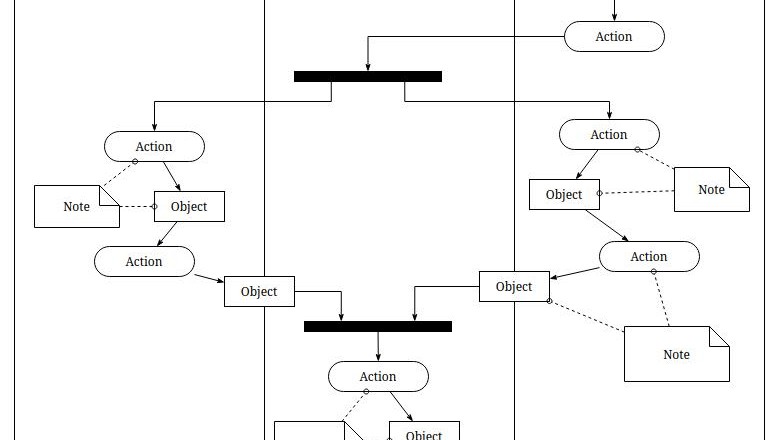
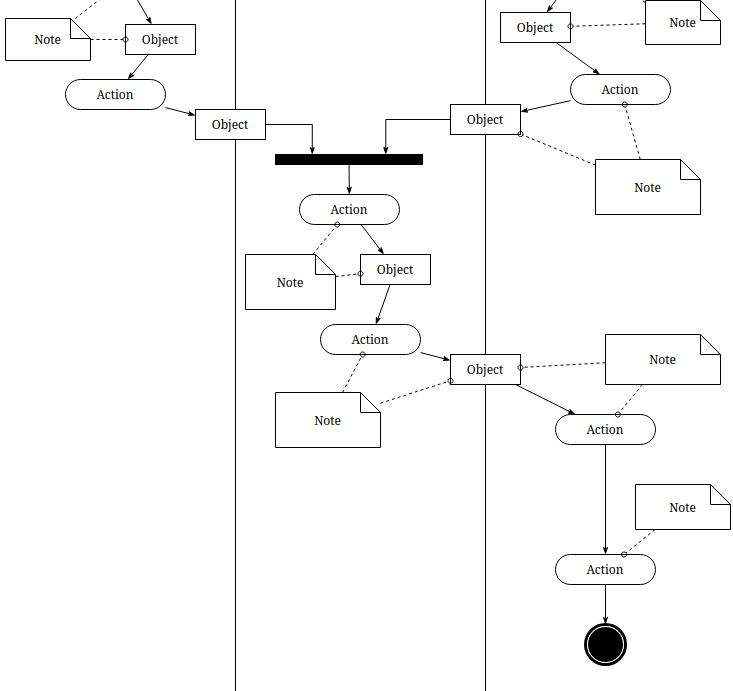
Activity diagrams serve a different purpose. I use them when I want to understand workflows, decisions, parallel behavior, responsibilities, and the flow of objects or information through a process.
The diagram below illustrates that distinction. It contains actions, object nodes, notes, partitions, synchronization bars, control flows, and a final node. Therefore, it does not describe an object model by itself. However, it can complement one by showing how objects participate in behavior.
I use different UML diagrams because no single diagram can explain every relevant view of a complex system.
A Practical Example: Modeling a Library
When I model a library, I first define the scope. Suppose I want to understand borrowing and returning books.
I might identify these concepts:
Member represents the person who can borrow items.
Book represents bibliographic information such as title and author.
BookCopy represents one physical copy that can actually be borrowed.
Loan connects a Member with a BookCopy for a defined period.
Reservation represents a Member’s request to receive an item later.
This distinction already improves the model. A library may own five copies of the same book. Therefore, I should not treat the abstract Book and the physical BookCopy as the same thing.
Next, I assign responsibilities.
A BookCopy can know whether it is currently available. A Loan can know its start date, due date, and status. A Member can hold the information and rules that belong to membership. A Reservation can track its position or state.
Then, I model collaboration. A borrowing scenario might require the system to identify a Member, select an available BookCopy, verify the borrowing rules, and create a Loan.
As a result, a large process becomes a collaboration between smaller concepts with clear responsibilities.
The Method I Use
When I apply object-oriented thinking to a new problem, I follow a simple sequence:
- I define the system boundary and the problem I want to solve.
- I identify the important domain concepts.
- I assign clear responsibilities to those concepts.
- I define their relationships and constraints.
- I model important scenarios to see how the objects collaborate.
- I refine the model when responsibilities become unclear or dependencies become unnecessarily complex.
This process remains iterative. New scenarios often reveal missing concepts or poor responsibility assignments. Therefore, I treat the model as something I continuously improve rather than something I create once.
Abstraction Helps Me Control Complexity
One of the greatest strengths of object-oriented thinking is abstraction.
I deliberately ignore details that do not matter at a particular level. For example, when I model a Loan, I may care about its due date and status. I probably do not care about the database table that will eventually store it.
Later, during technical design, those implementation details become relevant.
This separation helps me reason about the problem without mixing domain logic with infrastructure.
Good abstraction does not remove important information; it removes information that is not important for the current purpose.
I Avoid Common Modeling Mistakes
A weak object model often contains many objects but little meaningful behavior. Therefore, I do not judge a model by the number of classes it contains.
I also avoid creating one large object that controls almost everything. Such an object accumulates responsibilities and increases dependencies. Instead, I distribute responsibilities according to the concepts that own the relevant knowledge.
Another common mistake is starting with inheritance. I first ask what the concepts mean and how they collaborate. Only then do I decide whether inheritance represents a genuine relationship.
Finally, I do not confuse process decomposition with object decomposition. A process asks what happens and in what order. An object model asks which concepts exist, what responsibilities they have, and how they relate.
Both views can describe the same system. However, they answer different questions.
Why Object-Oriented Thinking Still Matters
Object-oriented thinking gives me a disciplined way to manage complexity. It helps me separate responsibilities, define boundaries, and understand dependencies.
Moreover, it creates a bridge between requirements, analysis, design, and implementation. A domain concept that appears during analysis can later influence classes, interfaces, services, tests, and business rules.
However, I do not treat object orientation as the correct solution for every problem. Functional programming, data-oriented design, process models, state machines, and other approaches can provide better abstractions in specific situations.
Object-oriented thinking is most valuable when objects, responsibilities, state, and collaboration provide a useful representation of the problem domain.
Final Thoughts
I see object-oriented thinking as a modeling discipline rather than a programming-language feature. I identify meaningful concepts. Then, I give them clear responsibilities and connect them through well-defined relationships.
UML can support this work through structural and behavioral views. However, the diagrams remain tools. The quality of the model depends on the quality of the abstractions behind them.
When I model responsibilities and relationships clearly, I can reduce complexity before that complexity reaches the software.
That is the main value of object-oriented thinking for me. It helps me understand a system before I decide how to build it.
What’s Next?!
Now that you’ve explored how object-oriented thinking shapes the way we design and understand systems, it’s time to take a closer look at why modeling matters in the first place. In my next article, “Why Model Requirements?” I’ll explain how modeling turns abstract ideas into clear, actionable insights. Join me to discover why structured requirements are the foundation for building reliable, efficient, and successful systems.
Explore the Bigger Picture with Requirements Modeling
If I want to understand requirements in a clear and structured way, I need more than written statements alone. I need models that make ideas, flows, and relationships visible. In the main article on Requirements Modeling, I explore essential Modeling Concepts, Process Modeling with BPMN, and the structural perspective of UML. Together, these topics help me analyze requirements more effectively, communicate them more clearly, and create a stronger foundation for successful system design.