
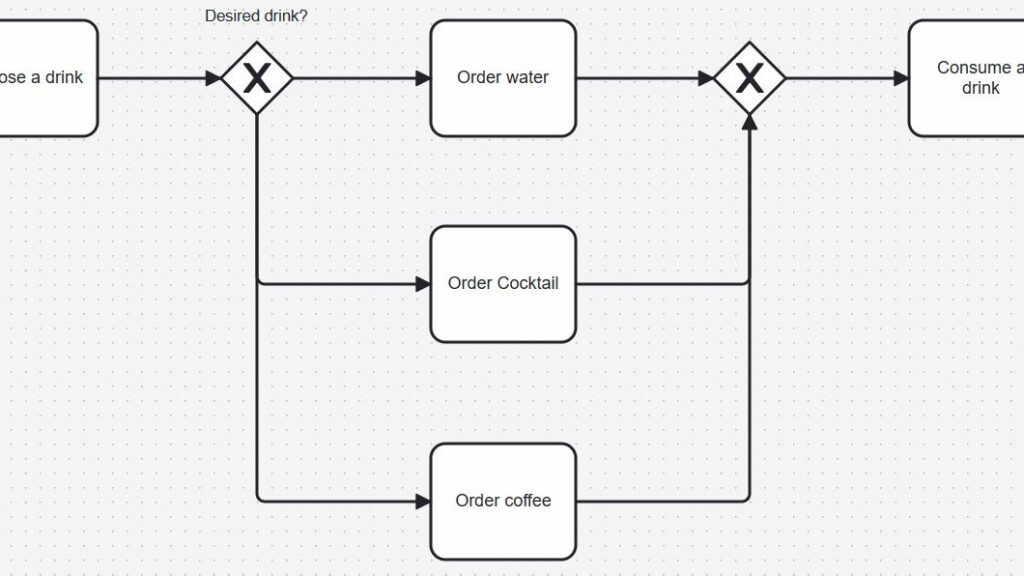
Exclusive gateways in BPMN 2.0 help me model clear decision paths in a process. They show that only one path continues after a condition is checked. Therefore, they are useful when I want to make business rules easy to understand. In this article, I explain exclusive gateways in BPMN 2.0 with a simple example so I can show how they work in practice and why they improve process clarity.
What Is an Exclusive Gateway in BPMN?
I use an exclusive gateway when a process reaches a decision with several alternatives, but only one alternative should continue.
BPMN represents the gateway as a diamond. I can place an X inside the diamond to identify it explicitly as an exclusive gateway. BPMN also allows the same gateway without the X marker. However, I prefer the X because readers can recognize the gateway type immediately.
The exclusive gateway is also called an XOR gateway. XOR means exclusive OR. In practical terms, the process follows one route or another, but not several routes at the same time.
An exclusive gateway represents one-of-many routing: one incoming process instance continues through one outgoing path.
This distinguishes it from a parallel gateway, which can activate several paths simultaneously.
How an Exclusive Gateway Makes a Decision
I can explain the logic with a simple drink example.
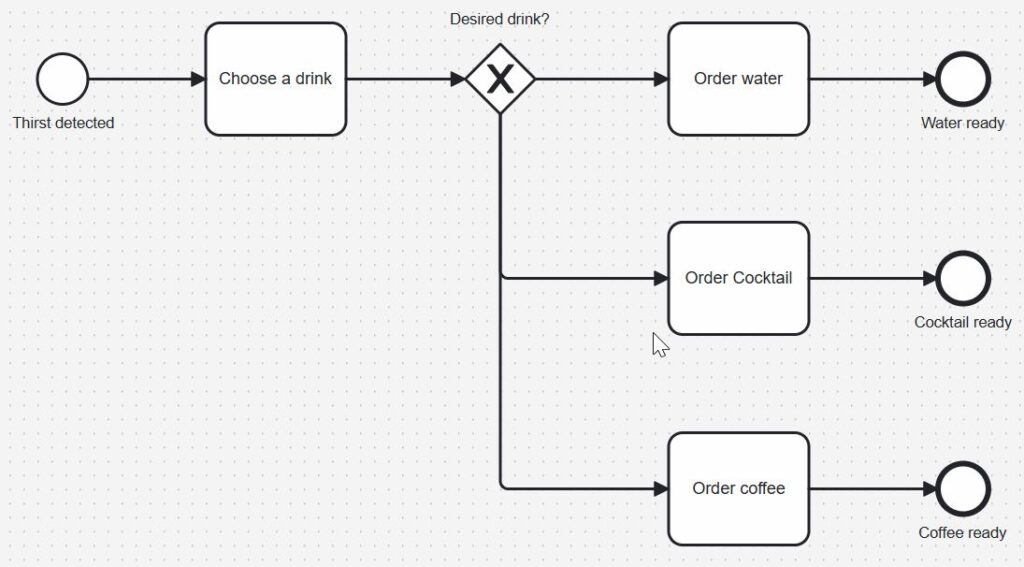
First, the process detects thirst. Then, I choose a drink. The process now contains the information required for the decision. For example, the choice could be water, a cocktail, or coffee.
Next, the exclusive gateway evaluates that information. Each outgoing Sequence Flow represents one possible result. Therefore, only the flow that matches the chosen drink continues.
This distinction matters.
The exclusive gateway does not perform the business decision. It routes the process according to conditions that already exist.
For example, the activity “Choose a drink” creates the relevant information. The gateway “Desired drink?” then uses that information to determine the next path.
Conditions Define the Outgoing Paths
In an executable BPMN process, I normally associate conditions with the outgoing Sequence Flows. The conditions determine which path the process takes.
For example, the three branches could represent these business rules:
Water is selected when the desired drink is water. Cocktail is selected when the desired drink is a cocktail. Coffee is selected when the desired drink is coffee.
The exact technical implementation depends on the process engine. However, the modeling principle remains the same.
I design the conditions so that only one outgoing condition can evaluate to true for the same process state.
This makes the decision genuinely exclusive.
Overlapping conditions create unnecessary uncertainty. For example, if two outgoing flows can both match the same data, the model no longer communicates a clear business rule. Therefore, I treat mutually exclusive conditions as an important modeling requirement rather than merely a technical detail.
What Happens If No Condition Matches?
An exclusive gateway also needs a valid route when none of its normal conditions matches.
I can solve this with a default Sequence Flow. The process takes this path when no other outgoing condition evaluates to true.
For example, I could define water, cocktail, and coffee as explicit alternatives and add another route for an unsupported selection. In a real business process, this might lead to an activity such as “Clarify drink selection.”
A default flow makes the process more robust because it defines what should happen in an unexpected case.
If I create an executable process without a matching condition or a suitable default path, the process may be unable to continue.
Therefore, I always ask what should happen when none of the expected conditions applies.
Exclusive Gateway vs. Event-Based Gateway
I do not use an exclusive gateway for every situation in which only one path should continue.
The important question is what determines the route.
An exclusive gateway evaluates process data. For example, it can evaluate a selected product, an order value, an approval result, or a customer category.
An event-based gateway works differently. It waits for an event, such as receiving a message or reaching a timer. The event that occurs determines the path.
Therefore, I use an exclusive gateway for data-driven decisions and an event-based gateway for event-driven alternatives.
The XOR gateway asks which condition is true, while an event-based gateway asks which event occurs.
That distinction prevents many modeling errors.
Using an Exclusive Gateway to Merge Paths
An exclusive gateway can also combine alternative paths.
In the drink example, water, cocktail, and coffee represent different activities. However, the process may continue with the same activity afterward. Regardless of the selected drink, I can consume it.
Instead of creating three separate copies of “Consume a drink,” I can merge the alternative paths and continue with one common flow.
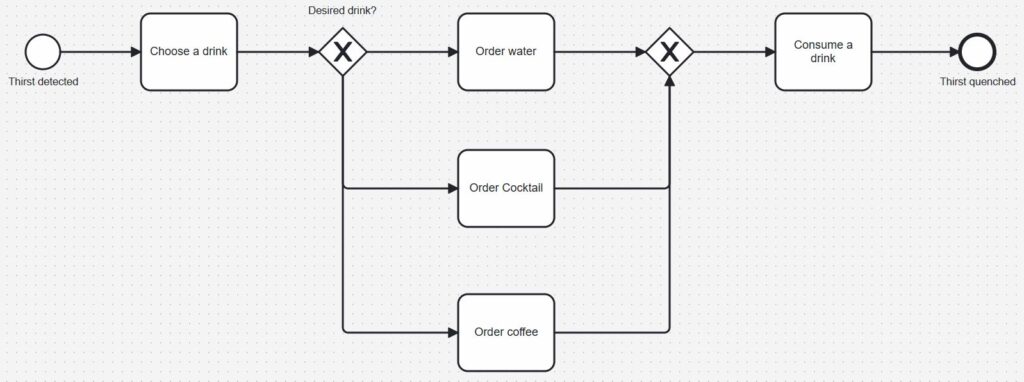
The second gateway acts as an XOR merge.
However, “merge” does not mean synchronization.
An exclusive gateway does not wait for every incoming path before continuing.
That behavior is correct because the first exclusive gateway activates only one of the three drink paths. Therefore, only one token should reach the merging gateway.
This is different from a parallel gateway. A parallel gateway can create several active paths and later synchronize them by waiting for all required branches.
Why the XOR Merge Matters
Technically, I can sometimes connect several alternative Sequence Flows directly to the same activity without adding a merging gateway. BPMN allows models where several incoming flows lead directly into one activity.
However, I often use an explicit XOR merge when it improves readability.
The first gateway then clearly means “choose one alternative.” The second clearly means “alternative paths become one process again.”
This structure also separates two different responsibilities:
The first gateway splits the process. The second gateway merges it.
I prefer separate gateways for splitting and merging because the resulting process logic is easier to read and maintain.
Although BPMN can support more compact structures, compact does not always mean clearer.
Do Not Use an XOR Merge for Synchronization
One limitation deserves special attention.
Suppose several incoming paths can actually become active at the same time. An exclusive gateway will not wait until every path arrives. Instead, an arriving token can continue through the gateway.
Consequently, an XOR merge can produce unexpected downstream behavior if I use it after parallel work.
When several activities must finish before the process continues, I use a parallel gateway or another synchronization mechanism that matches the required behavior.
Therefore, I first determine whether the preceding paths are alternatives or concurrent activities.
I merge mutually exclusive alternatives with an exclusive gateway, but I synchronize concurrent paths with a gateway designed for synchronization.
How I Model Exclusive Gateways Clearly
Clear notation matters as much as correct notation. Therefore, I give the gateway a short question or decision label when that improves understanding. “Desired drink?” works well because readers immediately understand what the process evaluates.
I also make the outgoing alternatives recognizable. A reader should not need to inspect technical implementation details to understand why the process follows a specific path.
Moreover, I avoid placing business work inside the gateway. If a person must assess an application, choose a product, classify a request, or approve a proposal, I model that work as an activity. I then use the gateway to route the process according to the result.
Finally, I prefer the X marker for exclusive gateways. The empty diamond is valid BPMN, but the marker reduces ambiguity, especially in diagrams that contain several gateway types.
Final Thoughts
Exclusive gateways are among the most useful BPMN elements because business processes frequently contain alternatives. I use them whenever process data determines which single route should continue.
The core logic is simple. An activity can create or change relevant process data. The exclusive gateway evaluates the resulting conditions. One alternative continues. Later, another exclusive gateway can merge those mutually exclusive paths into a common process flow.
A good exclusive gateway does not hide a decision. It makes the decision logic and its possible outcomes visible in the process model.
Once I keep decision-making, conditional routing, and path merging separate, XOR gateways become straightforward to model and much easier to explain.
What’s Next?
If I want to understand process modeling more completely, the next step is to look at the people behind the process work. That is why I continue with BPMN Project Roles for Effective BPM. In that article, I explain which roles support successful BPMN projects and why clear responsibilities matter so much. As a result, I can see how better role clarity improves communication, modeling quality, and process success.
Discover How Modeling and Processes Bring Order to Complexity
If I want to understand requirements in a clear and practical way, I need more than written statements alone. I need models that make concepts, workflows, and system structures visible. In the main article on Requirements Modeling, I explore essential Modeling Concepts, Process Modeling with BPMN, and the structural perspective of UML. Together, these topics help me analyze requirements more effectively, communicate them more clearly, and create a stronger foundation for successful system design.
With these insights, I can also move naturally into the main article on Processes. There, I explore Process Management, BPMN, and Camunda as a practical tool for BPMN modeling. Therefore, I can connect requirements with real workflows, process responsibilities, and improvement opportunities. Click through to learn how Processes help me structure work, improve collaboration, and turn process knowledge into practical business value.
Credits: The diagrams were created with Camunda.
| Read more on Business Process Modeling and Notation (BPMN) |
|---|
| Syntax and Semantics of BPMN BPMN Project Roles for Effective BPM The Participant Perspective in BPMN BPMN Core Elements |