
Understanding ITIL Change Control vs. Release Management

When I talk about release management, a common question arises: "What’s the difference between change control and release management?" It’s a valid question. At first glance, these two ITIL practices may seem similar. Many assume both handle approvals, deployments, and technicalities. But they serve distinct purposes in IT service management. In this post, I’ll break it down for you. I’ll use simple language, examples, and a business case to clarify how these practices work together. By the end, you’ll know exactly where each fits in.

Understanding ITIL Change Control vs. Release Management Read More »

ITIL Release Management Practice: An Essential Guide

Release management plays a critical role in ensuring smooth transitions from development to production environments. It’s a well-structured process that minimizes risks while maximizing efficiency and predictability. Whether you’re working with a traditional ITIL framework or navigating the fast-paced world of agile development, understanding and mastering release management practices is key.

ITIL Release Management Practice: An Essential Guide Read More »

ITIL Change Types: An Introduction

When managing IT services, one size does not fit all. Changes come in many forms, requiring distinct approaches. You can’t treat every change the same way, just like medical emergencies demand tailored responses. For instance, a sprained ankle needs basic care, while a car accident victim requires a full surgical team. Similarly, ITIL change management processes must adjust depending on the type of change at hand. Let’s break this down with business scenarios.

ITIL Change Types: An Introduction Read More »

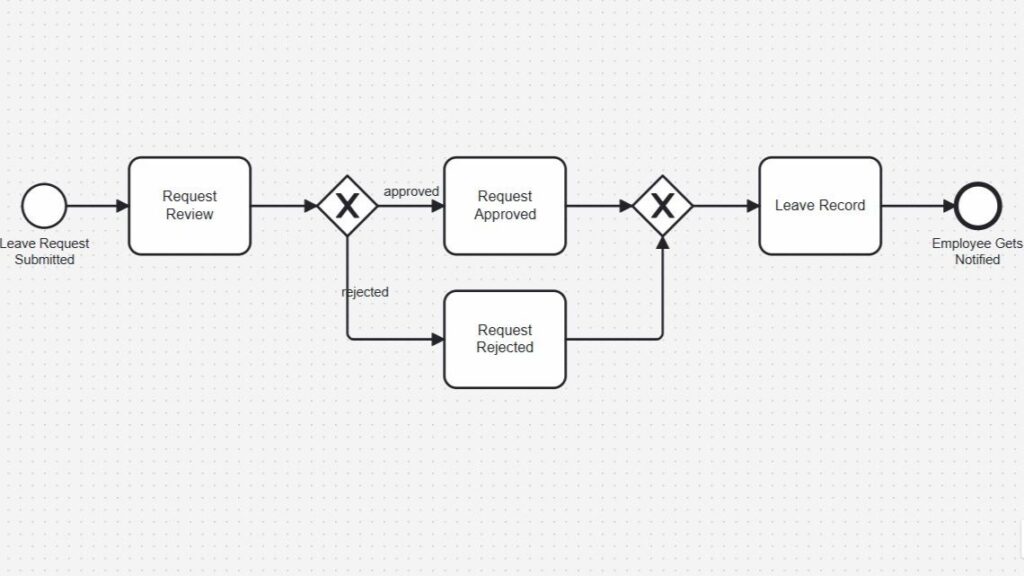
Leave request workflow with “Request Review,” branches to “Request Approved” or “Request Rejected,” then “Leave Record” and “Employee Gets Notified.”

Process Modeling: A Key to Streamlined Workflows

In today’s fast-paced business world, efficiency is everything. Companies need reliable ways to streamline operations and minimize human error. That’s where process modeling comes in. By visually mapping out workflows, organizations can uncover inefficiencies, improve coordination, and set the stage for automation. Let’s dive into the world of process management and see how modeling can

Process Modeling: A Key to Streamlined Workflows Read More »

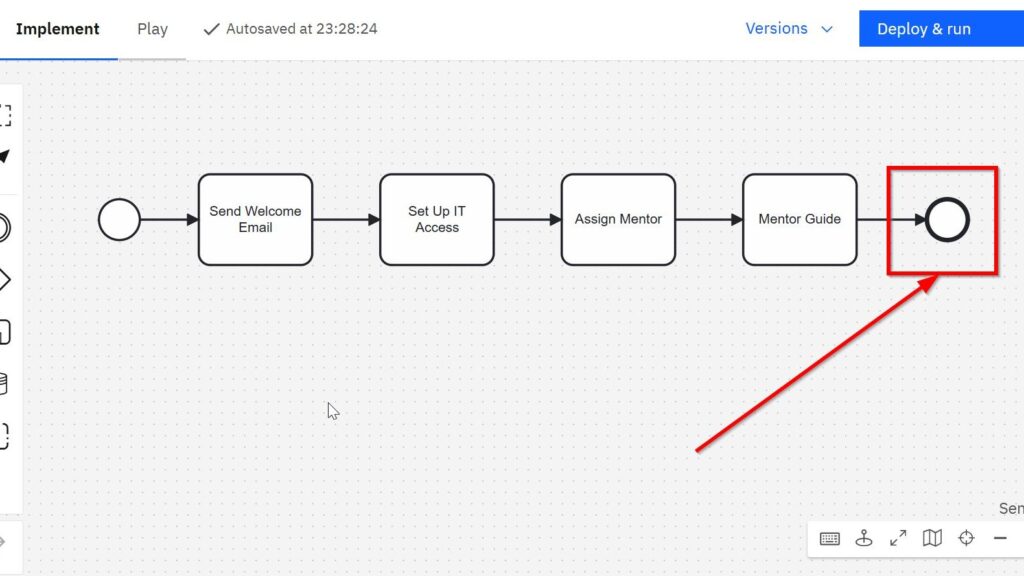
Diagram editor screenshot showing a sequence of steps (“Send Welcome Email,” “Set Up IT Access,” “Assign Mentor,” “Mentor Guide”) ending in a circle highlighted with a red box and arrow.

What is Process Management

When I first heard the term process management, I felt a bit overwhelmed. It sounded technical and complicated. However, I quickly learned that it shapes the way companies work every day. Understanding it changed how I viewed business operations. So, in this article, I explain what process management is, why it matters, and how BPMN helps visualize processes. Plus, I include a simple example with a diagram to make everything clear.

What is Process Management Read More »

Embracing ITIL Change Control Practice

Change is inevitable. In the IT industry, this couldn’t be truer. Every product, no matter how mature, requires updates to meet new organizational needs. Every service, even legacy ones, demands ongoing maintenance. Without change, stagnation takes over, and businesses risk falling behind. Yet, managing these changes is no small task. The challenge lies not in deciding whether to implement changes but in ensuring that changes happen without disrupting operations. Learn more about ITIL Change Control Practice in this article.

Embracing ITIL Change Control Practice Read More »

Zoomed-in draw.io screenshot highlighting two small square connection points on the left edge of a pink rectangle, marked with red boxes and arrows.

Connection Arrows and Points in draw.io

When I first started creating diagrams, I struggled with making my shapes and lines connect properly. Connections seemed to float randomly, and moving a shape often broke everything. However, I soon discovered the power of connection points and arrows in draw.io. These tools changed how I work with diagrams. Now, I create neat, organized, and professional diagrams in half the time. In this post, I will show you how to use connection points and arrows in draw.io to improve your diagramming skills.

Connection Arrows and Points in draw.io Read More »

ITIL Service Request Management

Managing service requests efficiently is crucial in today’s fast-paced IT environments. I believe ITIL Service Request Management offers a clear roadmap for fulfilling predefined service needs. With its structured approach, it ensures services meet agreed quality levels while being user-friendly. Let me guide you through what this practice entails and how businesses can leverage it effectively.

ITIL Service Request Management Read More »

Managing Changes in ITIL

Change is the lifeblood of progress. While IT operations ensure services run smoothly, static systems quickly become obsolete. For services and products to thrive, they must adapt, evolve, and innovate. Without change, stagnation takes hold, and stagnation means irrelevance. Think of any successful product. Can you name one that hasn’t changed over the years? It’s tough, isn’t it? Even everyday confectioneries update their offerings. Consider Oreos your chocolate bars. They consistently evolve to keep customers engaged. Yet, the rare anomaly – like "classic" Coca-Cola – demonstrates that even a return to something familiar is a strategic form of change. Learn more below how ITIL helps you manage changes.

Managing Changes in ITIL Read More »

Scroll to Top
WordPress Cookie Plugin by Real Cookie Banner