
What is a process? In business, a process is a structured sequence of activities that creates a result. It can support customer orders, product manufacturing, IT services, or daily operations. Clear processes improve efficiency, consistency, and quality. Therefore, process management helps organizations understand, control, and improve how work gets done.
What Is a Process?
I define a process as a structured sequence of related activities that leads from a starting point to a defined result.
For example, a customer places an order. This event starts an order process. The company checks the payment, verifies the inventory, packs the goods, ships the package, and confirms delivery.
Each activity contributes to the final result.
A process connects a defined trigger with a defined outcome through a logical sequence of activities.
Therefore, a process contains more than individual tasks. The relationships between those tasks matter as well. Their order matters. Decisions matter. Responsibilities also matter.
This structure makes the work understandable and repeatable.
What Are the Key Characteristics of a Process?
When I analyze a business process, I look for several basic characteristics.
A Process Has a Defined Start
Something must start the process.
For example, an incoming order can start an order process. A customer complaint can start a complaint process. Likewise, a scheduled date can start a monthly reporting process.
The trigger tells me why a particular process begins.
A Process Produces an Outcome
A process also needs a result.
For example, an order process should lead to a completed delivery. A support process should lead to a resolved request. A reporting process should produce a report.
Without a meaningful outcome, a sequence of activities does not form a useful business process.
Therefore, I always examine the result when I analyze a process.
Activities Follow a Logical Flow
Activities do not occur randomly.
Instead, dependencies determine their order. For example, a company normally verifies payment before it ships an order. Likewise, employees often need information from one activity before they can start the next activity.
The process structure represents these relationships.
A Process Creates Value
A process should contribute to a useful result.
Sometimes it creates direct customer value. For example, an order process delivers a purchased product.
However, internal processes also create value. Accounting processes support financial control. IT processes keep systems available. Compliance processes help organizations meet regulatory requirements.
Therefore, value does not always mean revenue. It means that the process contributes to an organizational objective.
A Process Uses Resources
Processes need resources to operate.
These resources can include people, time, information, software, machines, materials, and money.
For this reason, inefficient processes often consume more resources than necessary. Process analysis can reveal these problems.
A Process Should Be Repeatable
Organizations usually design processes because the same type of work occurs more than once.
For example, an online retailer does not invent a new order procedure for every customer. Instead, it follows a defined process.
Repeatability creates consistency, while consistency makes a process easier to control and improve.
However, repeatability does not mean that every process instance follows exactly the same path. Decisions and different conditions can create alternative paths.
A Process Needs Feedback
Finally, I consider feedback essential.
Performance data, errors, customer complaints, delays, and other observations show how the process performs in practice.
As a result, organizations can compare the intended process with actual behavior. They can then identify problems and improve the process.
Process Model and Process Instance
I distinguish between a process model and a process instance because they describe two different things.
Process Model
A process model describes the general structure of a process.
It shows which activities can occur and how they relate to each other. It can also represent decisions, events, responsibilities, and different paths.
The process model describes the process design rather than one specific execution.
For example, an order process model can describe how an online shop handles every normal customer order.
Process Instance
A process instance represents one concrete execution of that model.
When one customer places one order, a new instance of the order process begins. Another customer order creates another process instance.
Therefore, one process model can produce thousands of process instances.
I often think of the distinction this way:
The process model defines the general behavior. A process instance represents one real case.
This distinction becomes especially important when I analyze operational data. The model tells me how the process should work. Individual instances show me what actually happened.
Example: Order Processing in an E-Commerce Business
I can illustrate these concepts with a simple order process.
An online store receives an order. It then verifies the payment and checks whether the product is available. Next, employees pack and label the goods. The company ships the package. Finally, delivery confirmation completes the process.
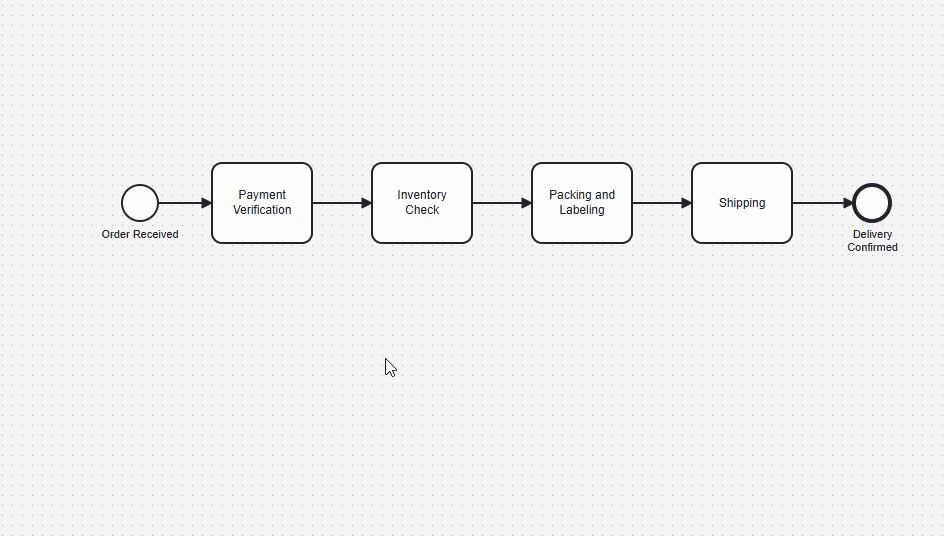
The process contains the following flow:
- Order Received: The incoming order starts the process.
- Payment Verification: The company verifies the customer’s payment.
- Inventory Check: The company checks whether the product is available.
- Packing and Labeling: Employees prepare the goods for shipment.
- Shipping: The company sends the package to the customer.
- Delivery Confirmed: Confirmation marks the successful outcome.
This simple example already contains the essential characteristics of a process. It has a clear start, a logical sequence, several activities, resource requirements, and a defined result.
How I Follow the Flow of a Process
When processes become more complex, I need a simple way to follow their behavior.
For this purpose, I can imagine a token moving through the process model.
The token represents the current position of a process instance. It starts at the beginning and follows the process flow from one element to the next.
For example, the token in the order process moves from payment verification to the inventory check and then to packing.
This idea becomes more useful when a model contains decisions or parallel activities.
The token concept helps me understand which paths a process instance can follow through a process model.
Therefore, I use it as an analytical concept rather than as another visible business object.
Why Correlation Matters
Processes rarely operate in complete isolation.
Messages, payments, documents, and system responses often need to reach the correct process instance. Therefore, the organization needs a way to identify which information belongs to which case.
I call this relationship correlation.
For example, an invoice can contain a reference number. When the customer pays the invoice, that reference allows the company to connect the payment with the correct transaction.
The same principle applies to order numbers, support ticket numbers, application IDs, customer references, and other identifiers.
Correlation connects incoming information with the correct process instance.
Poor correlation can create practical problems. A payment may reach the company but remain unmatched. A response may reach the wrong case. Consequently, employees need to investigate the issue manually.
Good process design therefore considers not only which activities occur, but also how information reaches the correct instance.
How BPMN Relates to Business Processes
When I want to represent a business process visually, I can use Business Process Model and Notation, or BPMN.
BPMN provides standardized elements for describing process behavior. For example, I can represent events, activities, decisions, flows, and interactions between participants.
However, I do not see BPMN as the process itself.
The business process describes how work happens. BPMN provides a language for modeling that behavior.
This distinction matters. A visually correct diagram does not automatically represent a good process. Therefore, I first need to understand the process, its purpose, its participants, and its logic. Only then can I model it effectively.
What Is Process Management?
Process management takes the next step.
I use process management to design, analyze, monitor, control, and improve business processes.
First, I need to understand how the process works. Next, I can identify delays, unnecessary activities, unclear responsibilities, errors, or excessive resource consumption.
Then I can improve the process.
For example, I might remove an unnecessary approval. I might automate a repetitive activity. Alternatively, I might improve the information flow between two departments.
Process management turns process knowledge into systematic improvement.
Therefore, the process model does not represent the final goal. It provides a foundation for understanding and improving how an organization works.
Final Thoughts
What is a process? At its core, I see a process as a structured path from a trigger to a valuable outcome.
A good process has a clear start and end. Activities follow a logical sequence. The process uses resources and creates value. Moreover, organizations can repeat, measure, and improve it.
I also distinguish the process model from its individual instances. The model describes the general behavior, while each instance represents one actual execution. In addition, the token concept helps me follow the process flow, while correlation connects information with the correct instance.
When I understand these fundamentals, I can model, analyze, and improve business processes with much greater precision.
What’s Next
Now that I have introduced process management, I can take the next step. I need to understand the basic concepts that make every workflow easier to analyze. Therefore, the next article gives me a clear foundation for process thinking.
Read Process Basic Concepts: Your Key to Clear Business Workflows next. In that article, I explain the core terms behind business processes in a simple way. As a result, you can understand activities, roles, inputs, outputs, decisions, and workflows with more confidence. This foundation helps you follow later process management topics much more easily.
Discover the Complete Path to Better Requirements
Read Requirements Engineering to see how I turn business needs into clear system direction. In that article, I connect elicitation, documentation, validation, testing, management, and system analysis into one complete overview. Therefore, you can understand how strong requirements reduce confusion, support better decisions, and guide successful IT solutions. As a result, requirements engineering becomes a practical foundation for building systems that truly fit stakeholder needs.
Read Management to explore how I connect key management disciplines into one practical overview. In the main article, I cover Management, Requirements Management in the IREB CPRE context, , and Process Management in the BPMN context. Therefore, you can see how business goals, requirements, services, and processes support each other. As a result, management becomes a clear framework for creating structure, direction, and long-term business value.
Read Processes to see how I connect process thinking with practical modeling. In the main article, I cover Process Management, BPMN, and Camunda as a tool for BPMN modeling. Therefore, you can understand how processes become visible, structured, and easier to improve. As a result, process work becomes a practical way to analyze workflows, design better operations, and support clear business decisions.
Credits: The diagrams were created with Camunda.