

When I analyze business processes, unclear responsibilities in process analysis often cause delays, confusion, and failure. I cannot improve a workflow until every task has a clear owner. In this article, I show how I use BPMN and a RACI matrix to define who is responsible, accountable, consulted, and informed.
What Does RACI in BPMN Mean?
BPMN and RACI describe responsibility from different perspectives.
I use BPMN to model how work moves through a process. Activities show what happens. Sequence flows show the order. In addition, lanes can organize activities by role, team, department, or another organizational category.
A RACI matrix answers a different question. It defines how people or roles participate in each activity:
- Responsible: performs or coordinates the work.
- Accountable: owns the result and has final accountability.
- Consulted: provides input before or during the work.
- Informed: receives relevant information about the work or its result.
BPMN shows the operational process, while RACI adds a responsibility structure that BPMN does not express on its own.
Therefore, I do not try to replace one method with the other. I combine them when responsibility needs more detail than the process diagram can provide.
How I Represent Roles in BPMN
I normally start with the participants who actively contribute to the process. Then I create lanes for the relevant roles.
For example, an offsite planning process could involve an Office Manager, Event Coordinator, HR Manager, and CFO.
The lane tells me which organizational role performs an activity. However, I do not interpret the lane as a complete RACI assignment. BPMN does not define whether someone is Accountable, Consulted, or Informed simply because that role appears in the diagram.
A BPMN lane identifies where an activity belongs organizationally. It does not represent the complete responsibility model.
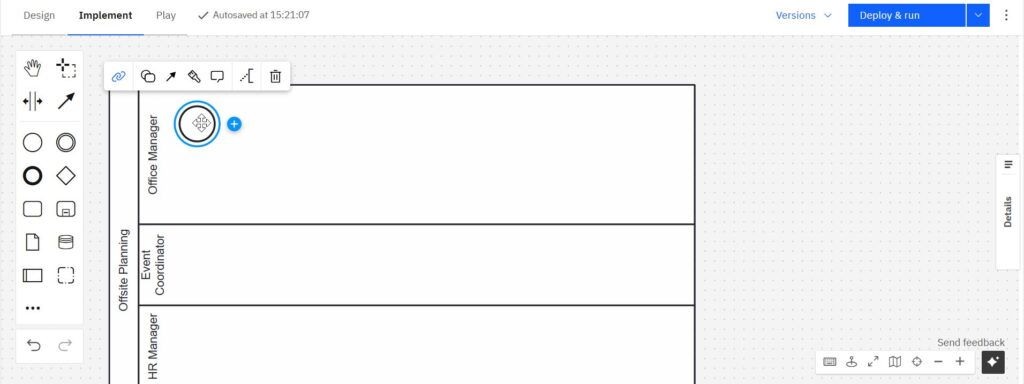
The first image works well here because it shows the organizational structure before the activities are added.
Assigning Activities to the Correct Roles
Next, I place each activity in the lane of the role that performs it.
In the example, the Office Manager chooses the location. The CFO approves the budget. The Event Coordinator then books the venue, sends the invitations, and coordinates the catering.
This already answers an important question: Who performs each activity?
However, it does not yet tell me who owns the final outcome, who must provide input, or who needs information. Therefore, I still need the RACI matrix.
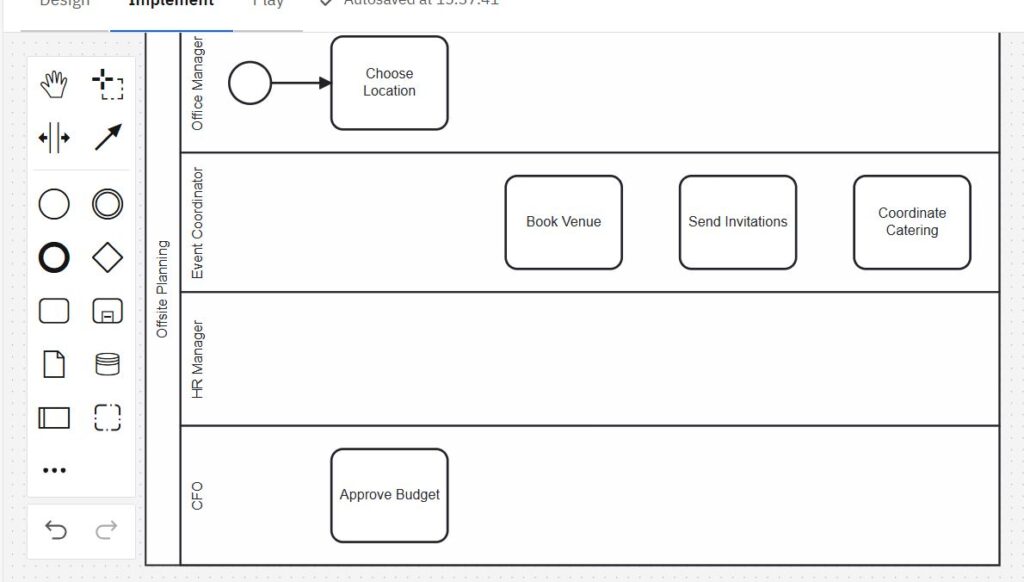
This image illustrates the connection between BPMN activities and operational responsibility particularly well.
Completing the Process Flow
After I place the activities, I define the process boundaries and connect the activities in their actual execution order.
The example starts when offsite planning begins. The Office Manager chooses a location. Next, the CFO approves the budget. After approval, the Event Coordinator books the venue, sends invitations, and coordinates catering. Finally, the process ends.
An end event makes the intended completion point explicit.
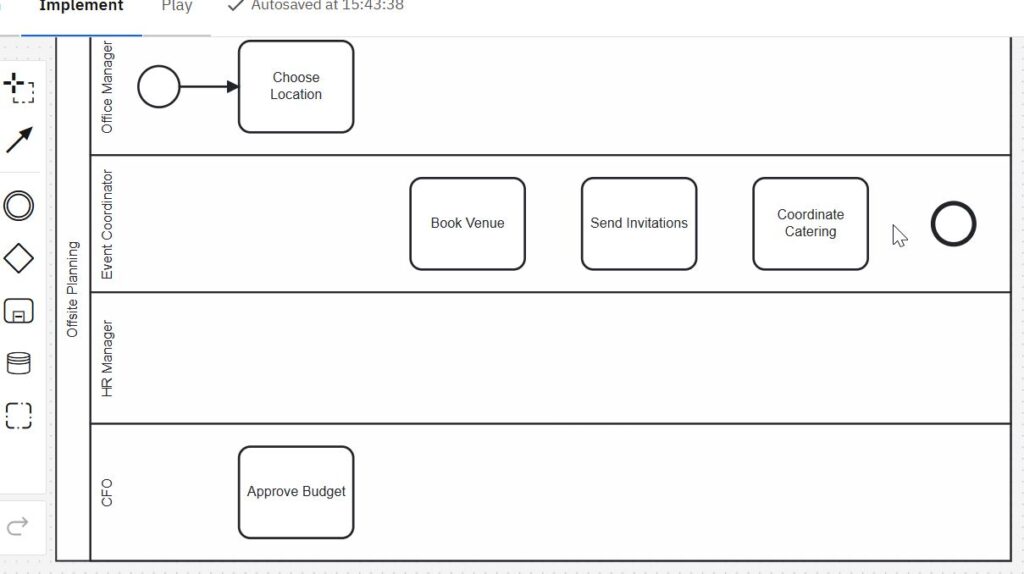
Then I connect the activities with sequence flows.
Because all roles belong to the same process participant, sequence flows can cross lane boundaries. For example, the flow can move from the Office Manager lane to the CFO lane and then to the Event Coordinator lane.
This distinction matters. I use sequence flows between activities inside the same pool. I do not use message flows merely because work passes from one lane to another.
Crossing a lane boundary does not mean that the process has crossed a participant boundary.
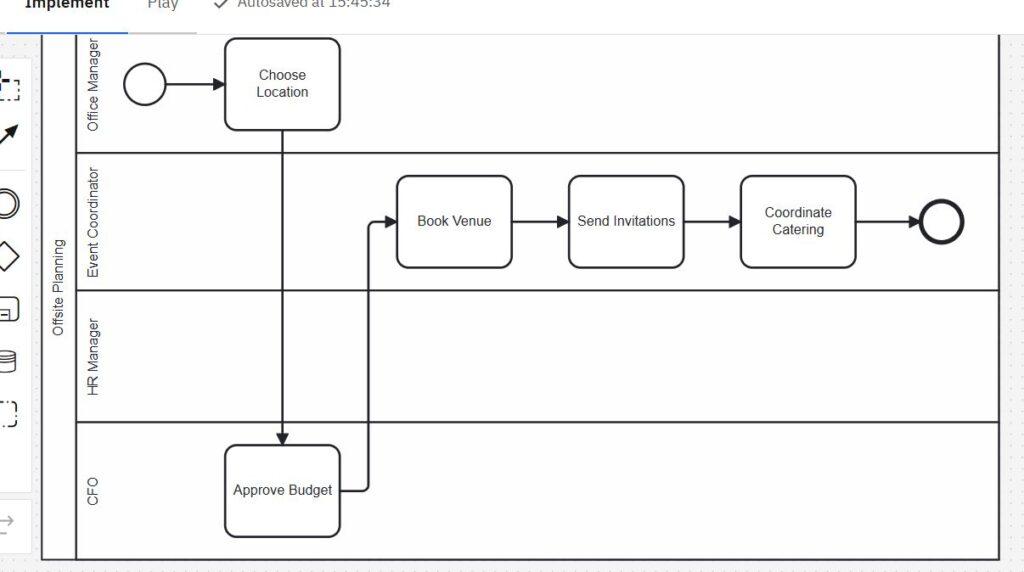
This should be the main process image because it shows the complete example.
Adding the RACI Matrix
Once the BPMN model is stable, I create the RACI matrix.
For this simple example, I would use the following assignments:
| Activity | Office Manager | Event Coordinator | HR Manager | CFO |
|---|---|---|---|---|
| Choose location | R/A | C | I | I |
| Approve budget | I | C | I | R/A |
| Book venue | I | R/A | I | I |
| Send invitations | C | R/A | I | I |
| Coordinate catering | I | R/A | C | I |
R/A means that the same role both performs the activity and owns its result. That is perfectly valid. RACI does not require Responsible and Accountable to be different people.
The matrix also corrects an important weakness that I often see in RACI models. Some matrices assign an Accountable person but no Responsible person. Others assign several Accountable people because nobody wants clear ownership.
I normally want one clear Accountable role for each activity, while one or more Responsible roles can perform the work.
Multiple Responsible roles can be appropriate. However, I use them deliberately. Too many Responsible roles can make coordination difficult.
What BPMN Can Show and What RACI Adds
The difference becomes clearer when I compare the two views.
If I look only at the BPMN diagram, I can see that the CFO performs the budget approval. I can also see what happens before and after that approval.
However, the diagram does not tell me whether the Event Coordinator must provide information before the decision. It also does not tell me who must receive information after the decision.
The RACI matrix captures those relationships.
Likewise, an I in a RACI matrix does not automatically mean that I should add an activity called “Inform HR” to the BPMN model. I add such an activity only when the communication represents relevant process behavior.
Therefore, I keep the process diagram focused on workflow behavior and use RACI for organizational responsibility.
How I Review a RACI-Based BPMN Model
When I review the combined model, I first compare every BPMN activity with its RACI row. The role marked Responsible should make sense in relation to the lane that contains the activity.
Next, I check accountability. Each important activity should have a clear owner. In addition, I examine Consulted assignments. Excessive consultation can slow a process significantly.
Finally, I review Informed roles. Information should have a purpose. Adding people to every row only creates communication overhead.
I also question empty lanes. For example, the HR Manager appears in the offsite model but performs no BPMN activity. That can still make sense if HR participates through consultation or information. However, if HR has no meaningful involvement at all, I would remove the lane.
Every role in the model should contribute information, work, authority, or accountability that matters to the process.
When I Use RACI Together With BPMN
I find the combination especially useful when a process contains approvals, handovers, several departments, governance requirements, or recurring disputes about ownership.
For a small and obvious workflow, BPMN lanes alone may provide enough clarity. In that case, an additional matrix would only create maintenance work.
However, as organizational complexity increases, the distinction becomes valuable. BPMN explains how the work proceeds. RACI explains how responsibility surrounds that work.
Final Thoughts
I use RACI in BPMN when lanes alone cannot answer all responsibility questions. BPMN gives me the operational view. RACI adds accountability, consultation, and information responsibilities.
Most importantly, I keep the two models consistent. If the BPMN diagram shows one role performing an activity while the RACI matrix assigns responsibility elsewhere, I investigate the difference.
A strong responsibility model does more than show who does the work. It makes ownership, decision authority, and communication explicit.
That is where BPMN and RACI complement each other best.
What’s Next
Now that I have clarified responsibilities in process analysis, I can move from clarity to improvement. Clear ownership helps me understand who does what. However, process optimization helps me make the workflow faster, smoother, and more valuable.
Read How I Improve Workflows Through Process Optimization next. In that article, I show how I identify weak points, remove unnecessary steps, and improve daily work with a structured approach. Therefore, you can see how better analysis turns into practical process improvement. As a result, you can create workflows that support clearer responsibilities, better performance, and stronger business outcomes.
Management Turns Optimization into Lasting Value
Read Management to see how I connect business goals, requirements, services, and processes in one practical overview. In the main article, I explore Management, Requirements Management in the IREB CPRE context, and Process Management in the BPMN context. Therefore, you can understand how process optimization fits into a broader management approach. As a result, management helps you improve workflows, strengthen services, and create sustainable business value.
Read Processes to see how I connect Process Management, BPMN, and Camunda in one practical overview. In the main article, I show how process management guides optimization, how BPMN makes improvement areas visible, and how Camunda supports BPMN modeling as a practical tool. Therefore, you can understand how process optimization becomes easier to analyze, discuss, and apply. As a result, processes help you improve workflows, reduce friction, and create better business outcomes.
Credits: Photo from Digital Buggu by Pexels
| Read more about Business Process Modeling and Notation (BPMN) |
|---|
| Exclusive Gateways in BPMN 2.0: Clear and Simple Parallel Gateways in BPMN 2.0: Understanding and Using Them Effectively Event-Based Gateways in BPMN 2.0: A Practical Guide Complex Gateways in BPMN 2.0: A Simple Guide |