
What is business process management? BPM helps organizations understand, control, measure, and improve their processes. It makes work visible, reduces errors, removes delays, and supports better results. Therefore, BPM turns daily work into a clear system for continuous improvement, stronger performance, and lasting business value.
I see BPM as the bridge between business goals and real operations. A strategy means little if daily work does not support it. In the same way, a process diagram means little if nobody uses it to improve work. Therefore, BPM connects goals, people, tasks, systems, data, and improvement into one practical discipline.
What is Process Management?
Before I explain BPM in more detail, I first need to clarify process management. Process management focuses on defining, monitoring, controlling, and improving workflows. Every organization depends on processes to create products, deliver services, solve problems, and support customers. Therefore, process management creates the foundation for structured and reliable business work.
A process describes how work moves from a starting point to a result. For example, a company receives an order, checks payment, verifies stock, packs the product, ships it, and informs the customer. Each step depends on people, systems, information, and decisions. Therefore, process management helps me understand how these parts work together.
Without process management, many problems appear slowly. Tasks become unclear. Responsibilities overlap. Handovers fail. Teams create workarounds. Customers wait longer. As a result, the organization loses time, quality, and trust.
Process management helps me prevent these problems. I can define clear steps. I can assign responsibilities. I can measure performance. In addition, I can improve weak points before they become serious business risks. Therefore, process management helps me turn unclear work into manageable work.
What is Business Process Management?
Business Process Management goes one step further. It does not only describe workflows. It aligns workflows with business goals. Therefore, BPM helps organizations design, execute, monitor, and improve processes in a structured way.
BPM asks practical questions. How does this process create value? Where do delays occur? Which tasks repeat too often? Which decisions need clearer rules? Which steps can we automate? How can we measure success? These questions make BPM useful for both business and IT.
I like BPM because it combines structure with improvement. It does not treat a process as a fixed document. Instead, it treats a process as a living system. Markets change. Customers change. Technology changes. Therefore, processes must also change.
The Core BPM Lifecycle
Business Process Management usually follows a clear cycle. This cycle helps me move from understanding to improvement. The BPM lifecycle gives me a structured way to analyze, model, execute, monitor, and optimize processes.
First, I analyze the current process. I look for problems, delays, errors, unclear responsibilities, and unnecessary steps. This gives me a realistic view of the current situation.
Next, I model the process. I create a visual representation of the workflow. This model helps stakeholders discuss the process with less confusion. In addition, it shows how tasks, decisions, events, and roles connect.
Then I execute the process. The organization performs the work based on the defined process. This can happen through manual work, software support, or automation.
After that, I monitor the process. I check performance, quality, compliance, and customer impact. Therefore, I can see whether the process works as intended.
Finally, I optimize the process. I use the collected insights to improve the workflow. As a result, BPM creates continuous improvement instead of one-time documentation.
Why BPM Matters
Business processes form the backbone of every organization. They turn ideas into results. They connect departments. They guide employees. They also shape the customer experience.
However, many organizations do not see their processes clearly. Work happens across teams, tools, emails, meetings, spreadsheets, and systems. Therefore, problems can stay hidden for a long time.
BPM makes these hidden structures visible. It helps me see where work starts, where it moves, and where it ends. In addition, it helps me identify bottlenecks and weak handovers. As a result, I can improve the full workflow instead of fixing isolated symptoms.
BPM also supports better decisions. Managers can base improvements on process facts instead of assumptions. Teams can discuss the same visual model. IT can understand business needs more clearly. Therefore, BPM improves communication between business and technology.
A Simple Example: Order Processing
Let’s take a simple order process. A customer places an order in an online shop. Without BPM, the workflow may look simple from the outside. However, many steps happen behind the scenes.
The system receives the order. Then the finance team or payment system checks the payment. Next, the warehouse checks inventory. After that, the fulfillment team packs the product. Then the delivery team ships the package. Finally, the system informs the customer and collects feedback. This order process shows how many activities must work together to create one customer result.
This process may sound straightforward. However, many problems can occur. Payment confirmation may arrive late. Stock data may be outdated. The warehouse may not receive the order on time. Shipping updates may fail. As a result, the customer may become frustrated.
With BPM, I can make every step transparent. I can see who owns each activity. I can identify where delays happen. I can also decide which steps need automation. Therefore, BPM helps the company improve speed, quality, and customer satisfaction.
The Example
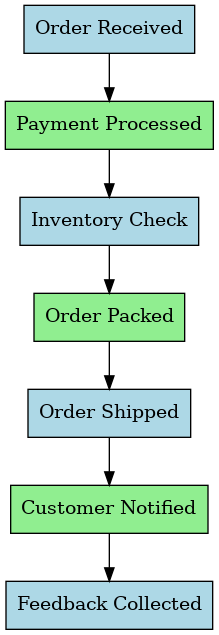
Let’s consider a business that processes customer orders. Without BPM, orders might get delayed, invoicing might be inconsistent, and tracking shipments could be chaotic. By implementing BPM, the company can streamline the workflow:
- Order Received → The system logs the customer’s order.
- Payment Processed → The finance team verifies and approves the payment.
- Inventory Check → The warehouse team confirms stock availability.
- Order Packed → The fulfillment team prepares the shipment.
- Order Shipped → The delivery team dispatches the package.
- Customer Notified → The system sends an update with tracking details.
- Feedback Collected → The company gathers insights to improve future orders.
In BPMN it would look like this:
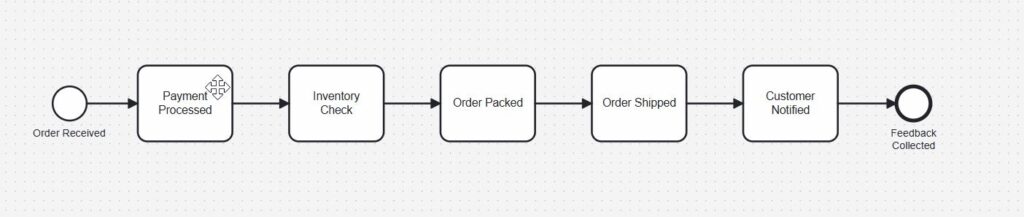
With BPM, the company gains transparency at every step. If a delay occurs, managers can pinpoint the issue and fix it quickly. Plus, automation can streamline many steps, reducing manual workload and human errors.
How BPMN Supports Business Process Management
BPMN stands for Business Process Model and Notation. It helps me visualize business processes in a clear and standardized way. Therefore, BPMN works well as a modeling language within BPM.
In BPMN, I can show events, activities, decisions, roles, and flows. For example, a start event can show when an order arrives. Tasks can show payment checks, inventory checks, packing, and shipping. Gateways can show decisions, such as whether stock exists. This visual structure helps business and IT teams work together.
Business stakeholders can explain the real workflow. Technical teams can understand what the process needs. In addition, managers can spot risks and improvement opportunities more easily. As a result, BPMN makes process discussions more concrete and useful.
BPMN does not replace BPM. Instead, it supports BPM. BPM is the management discipline. BPMN is a notation that helps me model and discuss processes. Therefore, both concepts fit together very well.
The Role of Technology in BPM
Technology plays a major role in modern BPM. Many processes run through software systems, workflow tools, ERP systems, CRM systems, ticket systems, and automation platforms. Therefore, BPM often connects business process design with digital execution.
A Business Process Management System, or BPMS, can help organizations execute and monitor processes. It can route tasks to the right person. It can trigger automated steps. It can collect process data. In addition, it can help managers see process performance in real time.
However, technology alone does not solve process problems. A bad process remains bad, even when a company automates it. Therefore, I always need to understand the process first. Then I can decide where technology creates real value.
This is an important lesson. BPM should not start with tools. It should start with goals, processes, people, and problems. After that, technology can support better execution.
Bridging Business and IT
One of the strongest benefits of BPM is its ability to bridge business and IT. Business teams often describe goals, needs, and pain points. IT teams often think in systems, data, interfaces, and automation. BPM helps both sides meet in the middle.
A clear process model shows what the business wants to achieve. It also shows how systems can support that goal. Therefore, BPM reduces misunderstandings between organizational needs and technical solutions.
This matters because markets move quickly. Customers expect fast service, reliable results, and high quality. Organizations must adapt processes, products, and systems faster than before. As a result, BPM becomes a strategic capability, not only an operational method.
Historical Background of BPM
Business Process Management combines ideas from business administration and computer science. Its modern roots became especially visible in the 1990s. During that time, many organizations started to focus more strongly on processes instead of isolated departments. This process-centered view shaped the modern understanding of BPM.
Michael Hammer and James Champy made business process redesign famous through their work on reengineering. They focused on radical redesign and dramatic performance improvement. Their approach showed that companies can rethink entire workflows instead of improving tiny parts.
However, radical redesign is not always the best option. Sometimes, smaller and continuous improvements create more sustainable results. This is where BPM becomes especially useful.
Thomas Davenport also shaped process thinking. He emphasized structured activities, clear outcomes, and customer-oriented results. This view helps me understand business processes as more than internal task chains.
Mathias Weske added a strong connection between organizational and technical environments. This perspective fits modern BPM very well. Today, processes often run across people, software, departments, and external partners. Therefore, BPM needs both business understanding and technical awareness.
Business Process Models and Process Instances
A business process model describes how a process should work. It acts like a blueprint. For example, an order processing model defines the general steps for handling customer orders. This model gives the organization a shared process structure.
A process instance is one real execution of that model. If ten customers place ten orders, the organization creates ten process instances. Each instance follows the same general model, but each case may contain different details.
This distinction matters. A model helps me define and improve the standard process. Instances help me analyze what happens in real life. Therefore, BPM needs both the planned process and the actual process data.
When I compare models and instances, I can find useful insights. Maybe the model looks efficient, but real cases often get delayed. Maybe employees skip steps because the process feels impractical. Maybe customers wait too long at one specific decision point. As a result, BPM helps me improve reality, not only documentation.
BPM as a Continuous Improvement Discipline
Business Process Management should never become a one-time project. A process model can become outdated quickly. Teams change. Tools change. Regulations change. Customer expectations change. Therefore, BPM needs continuous attention.
I use BPM to create a cycle of learning. First, I understand the process. Then I improve it. After that, I monitor results. Finally, I adjust it again when new insights appear.
This continuous cycle helps organizations stay adaptable. It also prevents process documentation from becoming useless over time. As a result, BPM supports long-term performance, not only short-term fixes.
Common Benefits of Business Process Management
BPM can create many benefits when organizations apply it well. It improves transparency because people can see how work flows. It improves responsibility because teams understand their roles. It improves quality because errors become easier to detect. In addition, it improves efficiency because unnecessary steps become visible.
BPM also supports compliance. Clear processes help organizations show how work should happen. This matters in regulated environments, public administration, finance, healthcare, and many other domains.
Most importantly, BPM improves customer value. A process should not exist only for internal control. It should help the organization deliver better results. Therefore, good BPM always connects internal workflow improvement with external value.
Final Thoughts
What is business process management? For me, BPM is the discipline that turns work into a clear, measurable, and improvable system. It helps organizations understand how work flows, where problems occur, and how processes can create more value.
BPM combines analysis, modeling, execution, monitoring, and optimization. It also connects business goals with operational reality. In addition, BPMN can help make processes visible and easier to discuss.
Therefore, Business Process Management is more than documentation. It is a practical way to improve how organizations work. When I use BPM well, I can reduce confusion, improve performance, support automation, and create better results for customers and the business. Business Process Management becomes valuable when it turns daily work into clear, structured, and continuously improved business performance.
What’s Next
Now that I have explained Business Process Management, I can look at the mindset behind effective process work. BPM gives me methods, models, and improvement cycles. However, process orientation helps me see the organization through the flow of value.
Read Why Process Orientation Matters next. In that article, I explain why organizations should not only think in departments, roles, or isolated tasks. Therefore, you can understand how process orientation connects people, activities, systems, and customer outcomes. As a result, you can build a stronger foundation for clear workflows and better business performance.
Management Turns Structure into Business Value
Read Management to see how I connect goals, requirements, services, and processes into one practical overview. In the main article, I explore Management, Requirements Management in the IREB CPRE context, and Process Management in the BPMN context. Therefore, you can understand how these disciplines support clear decisions, reliable services, and better workflows. As a result, management becomes a useful guide for creating structure, value, and long-term success.
Read Processes to see how I connect Process Management, BPMN, and Camunda in one practical overview. In the main article, I show how process management helps me understand workflows, how BPMN helps me model them clearly, and how Camunda supports BPMN modeling as a practical tool. Therefore, you can move from process thinking to visible process models. As a result, you can analyze workflows, improve operations, and make process knowledge easier to share.
Credits: The diagrams were created with Camunda.