When I work with requirements, I need clarity, structure, and a shared understanding. Because of this, I rely on modeling. It turns text into visual logic and reveals gaps or contradictions early. My motivation for requirements modeling comes from its ability to improve communication and support precise, reliable system understanding.
Why I Translate Text into Diagrams
Textual requirements describe system behavior. However, they often hide relationships between actions and decisions. Therefore, I convert them into diagrams. The visual structure exposes the actual logic. As a result, I understand the flow more clearly.
To illustrate this, I use a short set of textual requirements that contain an integrated condition inside the flow.
Textual Requirements Example
The following textual requirements are the business process-oriented starting point for the analysis and creation of system functionality:
Req-1: The system must display the login screen.
Req-2: After the login screen is displayed, the user must be able to enter a username and password.
Req-3: When the user submits the credentials, the system must verify whether the password is correct.
Req-4: If the password is correct, the system must load the dashboard.
Req-5: If the password is incorrect, the system must show an error and return to the login screen.
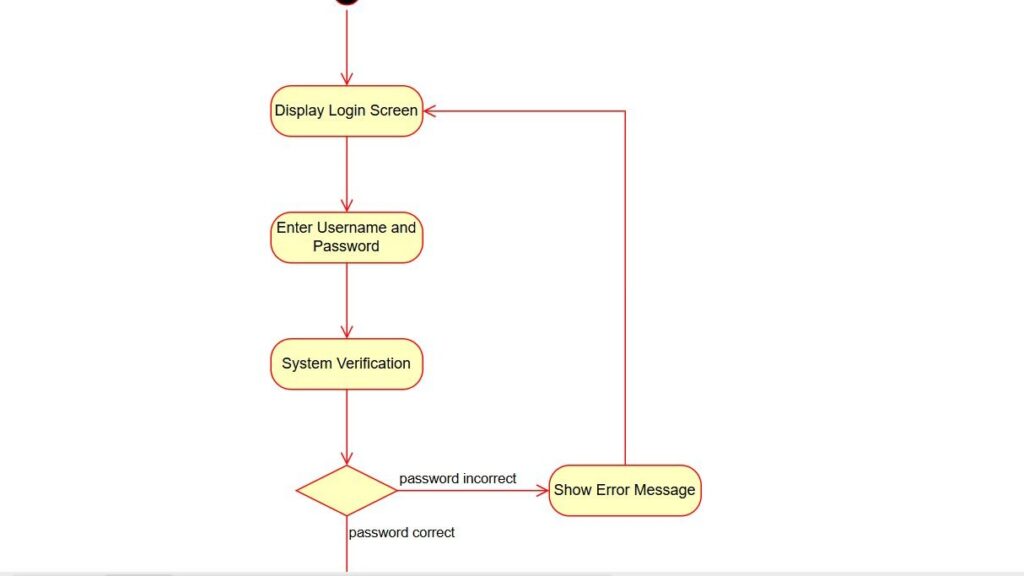
The following UML activity diagram now models the preceding textual requirements:
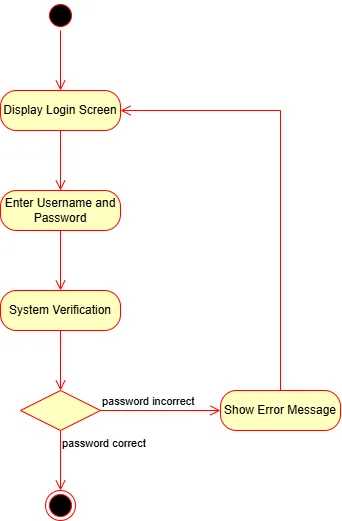
When I convert this sequence into an activity diagram, the decision becomes immediately visible and easy to understand.
Why Diagrams Improve Understanding
Text alone forces readers to imagine the logic. Consequently, misunderstandings appear quickly. However, a diagram shows steps, transitions, and conditional paths in a compact format.
In the example above, the diagram highlights a crucial point: credential validation. This single decision controls two very different outcomes. With a diagram, stakeholders instantly see the branch.
Moreover, diagrams reduce cognitive load. Instead of scanning paragraphs, people follow a simple flow. Because of this, I use diagrams whenever I want to support workshops, discussions, or reviews.
Why Modeling Helps Me Detect Issues Early
One of my strongest motivations for requirements modeling is early defect detection.
When I visualize the example above, several questions become obvious:
- Should the system lock the account after multiple failed attempts?
- Should the error screen allow password reset?
- Should the dashboard load with personalized content?
Text alone does not reveal these questions. The diagram exposes missing paths and incomplete rules immediately. Consequently, I can refine the requirements before development begins.
Additionally, I can identify contradictions. For instance, if one requirement stated “After an incorrect password, the system must exit the session”, the diagram would reveal the conflict instantly, because the flow currently returns to login.
Why Models Strengthen My Specifications
In many projects, I use diagrams as the primary form of specification. They express behavior in a compact and precise way. The text then acts as supporting material.
This approach has two major advantages:
- Consistency:
The model becomes the single source of truth.
When I update the flow, all generated documentation stays aligned. - Maintainability:
I can adapt the diagram quickly without rewriting long textual sections.
As a result, the overall specification becomes clearer, shorter, and more stable.
How the Example Demonstrates the Value of Modeling
The login example shows the benefits of modeling in a simple and effective way.
1. Clarity
The visual flow exposes the exact moment where the condition occurs and how the system reacts.
2. Understanding
Stakeholders see the path from login to validation and back to login in case of failure.
3. Quality
Missing requirements and inconsistencies become visible, such as missing lockout rules.
4. Specification Strength
The diagram forms the foundation.
The text explains conditions such as “password correct” and “password incorrect.”
Because the example shows all these advantages at once, it demonstrates why modeling is essential for high-quality requirements.
Conclusion
My motivation for requirements modeling is clear: it gives me a better way to understand and validate system behavior. Through diagrams, I uncover logic, conditions, and branching. Through text, I describe rules and context. Together, they give me a strong specification that reduces risks and improves communication.
Whenever I want clarity, I use models. And whenever the logic becomes complex, I rely on them even more.
This article covers concepts that are also included in the CPRE certification syllabus.