
Requirements prioritization techniques help me decide what to build first when time, budget, and capacity are limited. I use them to compare business value, user impact, risk, urgency, effort, and dependencies. Therefore, I avoid random decisions and make priorities clear. As a result, teams can focus on the requirements that create the most value and support realistic delivery.
What Are Requirements Prioritization Techniques?
Why Requirements Prioritization Matters
Core Criteria for Prioritizing Requirements
WSJF and Cost-Based Agile Prioritization
User Stories and Agile Backlog Prioritization
How I Choose the Right Requirements Prioritization Technique
Common Mistakes in Requirements Prioritization
Best Practices for Requirements Prioritization
Practical Example of Requirements Prioritization
Requirements Prioritization in Requirements Management
What Are Requirements Prioritization Techniques?
Requirements prioritization techniques are structured methods for ranking requirements. I use them when a project has more ideas, needs, or expectations than the team can deliver at once.
Requirements prioritization turns a long list of wishes into a clear order of action.
This matters because every software project has limits. Time is limited. Budget is limited. Team capacity is limited. Stakeholder attention is also limited. Therefore, I need a transparent way to decide what comes first, what comes later, and what does not belong in the current scope.
Good prioritization does not mean that I only choose the loudest request. It also does not mean that I only choose the easiest task. Instead, I compare several factors. I look at value, urgency, risk, effort, dependencies, and strategic fit. As a result, I can explain each priority with clear reasoning. Strong management of requirements also supports effective planning, monitoring, and coordination, which makes it highly relevant to Project Management Techniques.
Why Requirements Prioritization Matters
Requirements often compete with each other. One stakeholder wants faster delivery. Another stakeholder wants more features. The development team needs technical stability. The business wants measurable value. Meanwhile, users expect a product that solves real problems.
Therefore, I need a shared decision process.
Without prioritization, a project can become busy without becoming valuable.
Requirements prioritization helps me create focus. It also helps me protect the team from overload. In addition, it gives stakeholders a clear view of trade-offs. When I prioritize well, I do not just ask, “What do we want?” I also ask, “What creates the best result now?”
This approach improves planning. It supports release decisions. It reduces rework. Moreover, it helps teams deliver useful software earlier.
Core Criteria for Prioritizing Requirements
Before I choose a technique, I define my criteria. Otherwise, the method may look structured but still produce weak decisions.
I usually consider these criteria:
- Business value
- User value
- Risk reduction
- Legal or compliance need
- Time criticality
- Implementation effort
- Technical dependency
- Strategic alignment
- Stakeholder importance
- Learning value
A requirement should not move to the top only because someone asks for it loudly.
Instead, I need a balanced view. For example, a requirement with high business value may still need to wait if it depends on another feature. Likewise, a small requirement may deserve early delivery if it reduces major user frustration.
Therefore, I always connect prioritization to the project context. A startup MVP needs different priorities than a regulated banking system. A process automation project needs different priorities than a public website. As a result, the best technique depends on the decision I need to make.
MoSCoW Method
The MoSCoW method helps me group requirements into four priority categories. These categories are Must Have, Should Have, Could Have, and Won’t Have for now.
I use MoSCoW when stakeholders need a simple and fast way to discuss scope. It works well in workshops. It also works well when a team needs to define a minimum viable solution.
MoSCoW works best when the team defines clear rules for each category before the discussion starts.
A Must Have requirement is essential. Without it, the solution cannot work, cannot go live, or cannot meet a critical business need.
A Should Have requirement adds strong value. However, the solution can still work without it for a short time.
A Could Have requirement adds convenience or extra value. However, it does not decide project success.
A Won’t Have requirement stays outside the current scope. This does not always mean “never.” Often, it means “not now.”
How I Use MoSCoW
First, I collect the requirements. Then, I clarify the goal of the release, sprint, or project phase. After that, I place each requirement into one category.
However, I do not stop there. I challenge the result. Many teams put too many items into Must Have. Therefore, I ask clear questions.
Does the product fail without this requirement?
Does the business process stop without it?
Does a legal or contractual obligation require it?
Can we launch without it and add it later?
These questions make the discussion more honest.
Strengths of MoSCoW
MoSCoW is easy to understand. Therefore, it works well with mixed stakeholder groups. It also creates quick visibility. In addition, it helps teams avoid hidden assumptions about what “important” means.
Limits of MoSCoW
MoSCoW can become vague if I do not define the categories well. Stakeholders may also treat Should Have as Must Have. Therefore, I need strong facilitation.
The main risk of MoSCoW is priority inflation, because too many stakeholders want their requirements in the highest category.
Kano Model
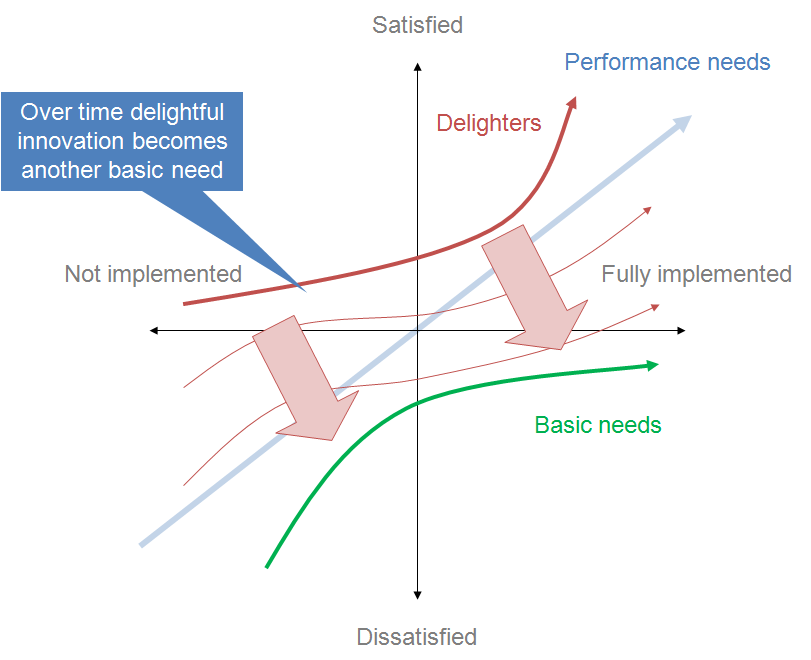
The Kano Model helps me understand how requirements influence customer satisfaction. I use it when user experience, product acceptance, or customer delight matters strongly.
The model separates requirements into different types. Some requirements create dissatisfaction when they are missing. Other requirements increase satisfaction when I improve them. Some requirements surprise users in a positive way.
The Kano Model helps me see that not every requirement creates value in the same way.
Basic needs are expected. Users may not praise them when they exist. However, users complain when they are missing. For example, users expect a login form to work reliably.
Performance needs create more satisfaction when I improve them. For example, faster search results can make users happier.
Delighters surprise users. Users may not ask for them directly. However, they can create strong positive reactions. For example, a smart suggestion feature can reduce manual work.
Indifferent requirements do not strongly affect satisfaction. Therefore, I should question whether they deserve effort.
Reverse requirements may reduce satisfaction for some users. For example, too much automation can frustrate users who need control.
How I Use the Kano Model
First, I collect user needs. Then, I ask how users feel if a requirement exists and how they feel if it does not exist. After that, I classify the requirement.
This helps me avoid a common mistake. I should not invest all effort into basic needs once they work well enough. Instead, I should meet basic expectations and then improve the areas that create visible value.
Strengths of the Kano Model
The Kano Model connects prioritization with user satisfaction. Therefore, it works well for product development. It also helps me identify features that users may not clearly request.
Limits of the Kano Model
The model needs user insight. Without research, interviews, surveys, or feedback, the classification can become guesswork. Also, customer expectations change. A delighter today can become a basic expectation tomorrow.
The Kano Model works best when I combine it with real user feedback.
Value vs. Effort Matrix
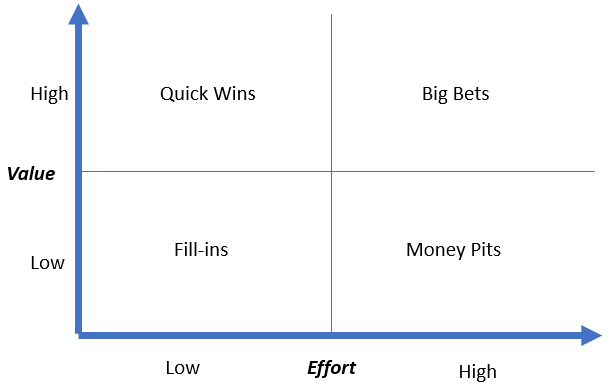
The Value vs. Effort Matrix helps me compare the expected value of a requirement with the effort needed to implement it. I use it when I need a quick visual overview of options.
The matrix has four areas. Each area supports a different decision.
Quick wins have high value and low effort. I usually prioritize them early because they create visible progress.
Major initiatives have high value and high effort. I treat them as strategic work. Therefore, I plan them carefully.
Fill-ins have low value and low effort. I may deliver them when capacity exists, but I do not let them distract the team.
Time wasters have low value and high effort. I usually avoid them unless a legal, technical, or contractual reason exists.
The Value vs. Effort Matrix helps me explain why easy work should not automatically come first.
How I Use the Value vs. Effort Matrix
First, I define what “value” means in the project. Value can mean revenue, customer satisfaction, risk reduction, process efficiency, or strategic fit.
Then, I define effort. Effort can include development time, testing effort, coordination effort, technical complexity, and change impact.
After that, I place each requirement in the matrix. Finally, I discuss the result with the team and stakeholders.
Strengths of the Value vs. Effort Matrix
The matrix is simple and visual. Therefore, it works well in workshops. It also makes trade-offs visible. In addition, it helps me avoid long debates about low-value ideas.
Limits of the Value vs. Effort Matrix
The matrix can oversimplify complex decisions. For example, a requirement with low direct value may still enable important future work. Also, effort estimates can change after technical analysis.
Therefore, I use the matrix as a decision aid, not as an automatic answer.
Cost of Delay
Cost of Delay helps me understand the cost of waiting. I use it when timing matters. This technique asks a simple but powerful question: What do we lose if we delay this requirement?
The loss can take different forms. The company may lose revenue. Users may continue to experience pain. The project may miss a market opportunity. A compliance risk may increase. A dependent team may wait.
Cost of Delay makes urgency visible instead of treating all important requirements as equally urgent.
For example, two requirements may both have high value. However, one requirement may lose value every week because customers need it now. The other requirement may stay valuable later. In that case, Cost of Delay helps me choose the time-critical item first.
How I Use Cost of Delay
First, I identify the value of the requirement. Then, I estimate how that value changes over time. After that, I compare delay impact across requirements.
I ask questions like these:
What happens if we deliver this one month later?
Does the delay create financial loss?
Does the delay increase operational risk?
Does the delay block another important feature?
Does the delay reduce customer trust?
These questions help me understand urgency.
Strengths of Cost of Delay
Cost of Delay supports economic thinking. Therefore, it works well for business-critical decisions. It also helps stakeholders move beyond personal preferences.
Limits of Cost of Delay
Cost of Delay can be hard to estimate. Sometimes I do not have exact numbers. However, I can still compare relative impact. Even a rough but transparent estimate can improve the discussion.
Cost of Delay is especially useful when market timing, compliance, revenue, or dependencies influence priority.
Weighted Scoring
Weighted scoring helps me compare requirements against several criteria. I use it when a decision needs more structure than a simple discussion can provide.
First, I define criteria. Then, I assign a weight to each criterion. After that, I score each requirement. Finally, I calculate a total score.
For example, I may use these criteria:
- Business value
- User impact
- Risk reduction
- Implementation effort
- Strategic fit
- Time criticality
A requirement with high value, strong user impact, and low effort will likely score well. However, a high-effort requirement can also score well if it supports a major business goal.
Weighted scoring helps me make complex prioritization decisions more transparent.
How I Use Weighted Scoring
I start with a small number of criteria. Too many criteria make the method heavy. Then, I agree on the scoring scale. For example, I may use a scale from 1 to 5.
Next, I score the requirements with stakeholders and the team. I also document assumptions. This matters because the score should not look more precise than it really is.
Strengths of Weighted Scoring
Weighted scoring creates a clear decision trail. Therefore, it works well when stakeholders need to understand why one requirement ranks higher than another.
Limits of Weighted Scoring
The method can create false precision. A score is not the truth. It is a structured estimate. Therefore, I always review the final ranking and check whether it makes sense.
WSJF and Cost-Based Agile Prioritization
Weighted Shortest Job First, often called WSJF, helps me prioritize work by comparing cost of delay with job size. I use the idea when I want to deliver high-value, time-critical work early.
The basic logic is simple. A requirement becomes more attractive when it has high urgency and relatively low effort.
This approach fits agile environments because teams often need to choose the next best backlog items. However, I do not use it mechanically. I still check dependencies, risks, and stakeholder context.
WSJF helps me avoid spending too much time on large items while smaller urgent items wait.
When I Use WSJF
I use WSJF when several requirements compete for the same team capacity. It helps me compare work items that differ in size, value, and urgency.
For example, a small feature may remove a major customer pain point. A larger feature may bring value later but require more preparation. In that case, WSJF can help the team make a better sequencing decision.
Limits of WSJF
WSJF depends on estimates. If the team estimates value, urgency, or job size poorly, the result can mislead the decision. Therefore, I use WSJF together with discussion and review.
Risk-Based Prioritization
Risk-based prioritization helps me decide which requirements need early attention because they contain uncertainty or potential problems.
I use this technique when a requirement may affect architecture, security, performance, compliance, feasibility, or integration.
Risk-based prioritization helps me reduce uncertainty before it becomes expensive rework.
Some requirements look attractive but hide major technical risks. Others look simple but affect sensitive data, legal rules, or critical business processes. Therefore, I do not only ask, “What creates value?” I also ask, “What could go wrong if we handle this too late?”
How I Use Risk-Based Prioritization
First, I identify risks. Then, I assess probability and impact. After that, I prioritize requirements that help reduce the most important risks.
For example, I may prioritize a technical proof of concept before a large feature build. This can reveal whether an integration works. It can also show whether the chosen solution performs well enough.
Strengths of Risk-Based Prioritization
This technique protects the project from late surprises. It also supports better planning. In addition, it helps stakeholders understand why some technical work deserves early attention.
Limits of Risk-Based Prioritization
Risk-based prioritization can push visible user features back. Therefore, I need to explain the reason clearly. I also need to balance risk reduction with business value.
Collaborative Prioritization
Collaborative prioritization means that I involve the right people in the priority decision. This does not mean that everyone decides everything. Instead, it means that I gather the knowledge needed for a good decision.
I involve business stakeholders, users, product owners, developers, testers, architects, support teams, and operations when needed.
Good prioritization needs business insight, user insight, and technical insight.
If I only ask business stakeholders, I may miss technical complexity. If I only ask developers, I may miss business urgency. If I only ask users, I may miss strategic goals. Therefore, I combine perspectives.
How I Use Collaborative Prioritization
First, I define the decision scope. Are we prioritizing a release, a sprint, a backlog, or a roadmap?
Then, I define the decision criteria. After that, I invite the right people. During the discussion, I make assumptions visible. I also separate facts from opinions.
Finally, I document the decision. This protects the team from repeated debates.
Strengths of Collaborative Prioritization
Collaborative prioritization increases shared understanding. It also builds trust. Moreover, it helps stakeholders accept trade-offs because they see how the decision happened.
Limits of Collaborative Prioritization
Collaboration can become slow when too many people join. Therefore, I keep the group focused. I also make clear who provides input and who makes the final decision.
User Stories and Agile Backlog Prioritization
User stories help me describe requirements from a user perspective. However, a user story is not a prioritization technique by itself. It becomes useful for prioritization when I combine it with value, effort, risk, and urgency.
A strong user story clarifies who needs something, what they need, and why they need it. This helps me understand the expected outcome.
User stories help me prioritize better because they connect requirements to user goals.
In agile work, I usually prioritize the product backlog. I place the most valuable and ready items near the top. However, I also consider dependencies, team capacity, and learning goals.
For example, I may prioritize a smaller story first because it tests an important assumption. I may also split a large story because the team cannot deliver it in one iteration. Therefore, backlog prioritization often includes refinement, slicing, and sequencing.
What I Check Before I Prioritize a User Story
I ask whether the story has a clear user goal. I check whether acceptance criteria exist. I also check whether the team understands the scope.
If the story remains vague, I do not treat it as ready for delivery. Instead, I refine it first.
Prioritization only works well when the requirements are clear enough to compare.
How I Choose the Right Requirements Prioritization Technique
No single technique fits every situation. Therefore, I choose the method based on the decision I need to make.
If I need fast scope discussion, I use MoSCoW.
If I need customer satisfaction insight, I use the Kano Model.
If I need a visual workshop tool, I use the Value vs. Effort Matrix.
If timing matters, I use Cost of Delay.
If I need a structured comparison, I use Weighted Scoring.
If I work in an agile backlog with urgency and job size, I use WSJF.
If uncertainty matters, I use Risk-Based Prioritization.
If acceptance matters, I use Collaborative Prioritization.
The best requirements prioritization techniques match the project context, not personal preference.
Sometimes I combine techniques. For example, I may start with MoSCoW to create a rough scope. Then, I may use weighted scoring for the most difficult trade-offs. After that, I may use risk-based prioritization to decide what the team should validate early.
This layered approach works well because prioritization often needs more than one view.
Common Mistakes in Requirements Prioritization
Prioritization can fail even when the team uses a known technique. Therefore, I watch for common mistakes.
One mistake is unclear criteria. If nobody defines value, everyone interprets it differently.
Another mistake is stakeholder dominance. A loud stakeholder can distort the result.
A third mistake is missing technical input. A requirement may look simple from the outside but carry major implementation risk.
A fourth mistake is permanent priorities. Priorities change when new information appears. Therefore, I review them regularly.
A fifth mistake is too much detail too early. Some requirements need discovery before precise ranking makes sense.
Prioritization is not a one-time decision; it is a continuous management activity.
Best Practices for Requirements Prioritization
I start with a clear goal. The team must know whether we prioritize for a sprint, release, roadmap, or project phase.
Then, I define decision criteria. This avoids random debates.
Next, I involve the right people. I include business, user, and technical perspectives.
After that, I keep the method simple enough. A complex scoring model does not help if nobody trusts it.
I also document the reasoning. This helps later when stakeholders ask why a requirement moved up or down.
Finally, I review priorities when conditions change. New risks, new market needs, new regulations, or new feedback can change the order.
Requirements prioritization works best when I make trade-offs explicit and understandable.
Practical Example of Requirements Prioritization
Imagine I work on a customer portal. Stakeholders request these requirements:
- Secure login
- Password reset
- Invoice download
- Profile picture upload
- Live chat
- Admin dashboard
- Dark mode
- Payment history
- Performance improvement
- Legal consent tracking
First, I identify Must Have requirements. Secure login, password reset, invoice download, and legal consent tracking may belong in this category.
Then, I look at value and effort. Payment history may create strong user value. Profile picture upload may create low value. Therefore, I would not place both on the same level.
Next, I check risk. Legal consent tracking may carry compliance risk. Performance improvement may reduce technical and user risk. Therefore, I may prioritize both earlier than a visible but less important feature.
After that, I check Cost of Delay. If customers urgently need invoice downloads before a tax deadline, this requirement becomes time-critical.
Finally, I discuss the result with stakeholders and the team.
This example shows why prioritization must compare value, urgency, effort, risk, and context together.
Requirements Prioritization in Requirements Management
Requirements prioritization belongs directly to requirements management. I do not only collect and document requirements. I also control them over time.
This means I track changes. I manage scope. I clarify dependencies. I support decisions. I help stakeholders understand trade-offs.
Prioritization also connects requirements management with project management. Project managers need realistic plans. Product owners need ordered backlogs. Development teams need focus. Testers need to know which areas matter most. Stakeholders need transparency.
Strong requirements management uses prioritization to connect stakeholder needs with realistic delivery.
Without this connection, a requirements list can grow without direction. With prioritization, the list becomes a managed decision base.
Final Thoughts on Requirements Prioritization Techniques
Requirements prioritization techniques help me create focus in software projects. They help me decide what matters now, what can wait, and what does not fit the current goal.
I use MoSCoW for scope clarity. I use the Kano Model for customer satisfaction. I use the Value vs. Effort Matrix for visual decisions. I use Cost of Delay when timing matters. I use weighted scoring for structured comparison. I use WSJF for agile sequencing. I use risk-based prioritization to reduce uncertainty. I use collaborative prioritization to include the right perspectives.
The real value of requirements prioritization techniques lies in better decisions, clearer trade-offs, and stronger delivery focus.
Therefore, I do not treat prioritization as a side task. I treat it as a core part of requirements management. As a result, I can help teams build the right things first and deliver software that creates real business and user value.akes sure development projects are successful. So, these methods are great for managing development project tasks.
Understand Management as the Bigger Decision Framework
If you want to see how prioritization fits into the bigger picture, continue with Management. In the main article, I explain how management, requirements management, and process management work together. This wider view helps you connect priorities with clear decisions, controlled requirements, reliable services, and better processes. It also builds on Requirements Engineering, where I elicit stakeholder needs, document requirements clearly, validate them early, and connect them with testing. In addition, system analysis turns business goals into structured solutions. Therefore, the Management article gives you the broader foundation for better software decisions and stronger project results.
Image credits: Photo by Christina Morillo from Pexels | Kano model: from Wikimedia Commons under Creative Commons Attribution-Share Alike 3.0 Unported