
At first, learning how to determine simple UML relationships can seem challenging, but with the right approach, it becomes much clearer. By applying a few practical heuristics, you can easily identify how classes and objects connect within your model. In this article, I’ll explain how to determine simple UML relationships step by step, using real examples and scenarios that make the process intuitive and effective for building a structured, meaningful class diagram.
Start With Two Related Classes
A simple UML relationship usually connects two classes. UML calls this a binary association.
For example, I may identify the classes Person and Address. I then ask how instances of these classes relate.
A person may live at an address. In addition, a person may use an address as a correspondence address.
I model a relationship when the connection between two concepts contains relevant information for the requirements.
1. Look for Verbs
Verbs provide one of the strongest clues.
For example:
- Person lives at Address.
- Employee supervises Department.
- Customer places Order.
The verb often gives me a suitable association name.
In the Person example, “lives at” directly describes the relationship between Person and Address.
However, I do not model every verb. I first check whether the system needs to know or use the relationship.
2. Look for Different Roles or Meanings
The same two classes can have several relationships.
For example, Person and Address can relate through:
- lives at
- correspondence address
These relationships have different meanings. Therefore, I model them separately when the distinction matters.
Two classes can have several associations when their objects relate in different ways.
3. Use Quantifiers to Determine Multiplicity
Next, I look for words such as:
- exactly one
- one or more
- several
- any number
- optional
These expressions help me determine multiplicities.
For example, a requirement may state that each Person has exactly one correspondence address. At the same time, several persons may share the same Address.
In UML, I can represent this with multiplicities such as 1 and *.
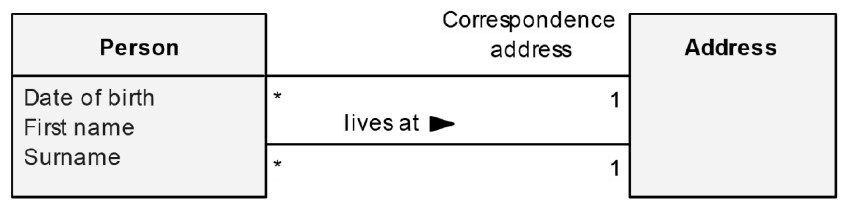
The image is especially useful here because it combines all three heuristics. Person and Address are the classes. “Lives at” and “correspondence address” distinguish the relationships. Finally, the multiplicities specify how many objects may participate.
In this model, the 1 at the Address end means that each Person relates to exactly one Address for the respective association. The * at the Person end means that one Address can relate to multiple persons.
Multiplicity turns a general relationship into a more precise domain rule.
4. Check Classes Without Relationships
Finally, I look for classes that have no associations.
A disconnected class can be valid. However, it can also indicate that I missed an important relationship.
Therefore, I ask why the class belongs in the information model and how it relates to the other concepts.
I do not add an artificial association simply to connect it. Instead, I return to the requirements and check whether a relevant relationship exists.
My Heuristic in Practice
I use a simple sequence:
- Identify two relevant concepts.
- Look for verbs that connect them.
- Check whether different roles require separate associations.
- Look for quantifiers and determine multiplicities.
- Review disconnected classes for possible missing relationships.
These heuristics give me relationship candidates, but the requirements determine whether those relationships belong in the final model.
Conclusion
To determine simple UML relationships, I analyze how relevant concepts connect in natural-language requirements.
Verbs help me identify associations. Different meanings can reveal several relationships between the same classes. Quantifiers help me determine multiplicities. Finally, disconnected classes can expose missing relationships.
A useful UML association states not only that two classes relate, but also how they relate and how many objects may participate.
What’s Next?!
Now that you’ve explored how to identify simple UML relationships and connect your classes meaningfully, it’s time to look inside those classes. In my next article, ‘What Are UML Class Attributes? A Quick Guide,’ I’ll explain how an attribute defines the structure and identity of each class. Join me to learn how mastering class attributes adds detail, precision, and clarity to your UML models.
Discover How Requirements Modeling Connects Ideas, Processes, and Structure
If I want to understand requirements in a deeper and more practical way, I need more than text alone. I need models that show how concepts, workflows, and system structures fit together. In the main article on Requirements Modeling, I explore essential Modeling Concepts, Process Modeling with BPMN, and the structural perspective of UML. Together, these topics help me analyze requirements more clearly, communicate them more effectively, and create a stronger foundation for successful system design.
This article covers concepts that are also included in the CPRE certification syllabus.