
Understanding the difference between a process and an algorithm helps in business and technology. I often see both terms mixed up, but they describe different ideas. A process shows how work flows through people, roles, and results. An algorithm defines exact steps to solve a problem. In this article, I explain process vs. algorithm and show how both concepts can support each other.
What Is a Process?
I use a process to describe how work reaches a defined result. It connects activities, decisions, events, responsibilities, and handovers.
For example, an invoice approval process may involve accounting, another department, a manager, and a payment system. The process tells me when each participant becomes involved and what happens next.
Therefore, a process answers questions such as:
- What starts the work?
- Which activities must happen?
- Who performs each activity?
- Which decisions change the flow?
- What happens when something goes wrong?
- When does the process end?
I can document such a process with BPMN. BPMN gives me standardized elements for activities, events, gateways, sequence flows, and participants.
A process primarily describes the organization and flow of work from a business perspective.
However, a process does not need to define every internal rule in technical detail. A task such as “Formal Check” may represent dozens of individual validation rules without showing them all in the process model.
What Is an Algorithm?
I use an algorithm when I need precise rules for solving a defined problem.
An algorithm takes an input, applies a sequence of instructions, and produces a result. Those instructions should be sufficiently clear that the same conditions lead to predictable behavior.
For example, an algorithm could determine whether an invoice passes a formal check. It might verify whether the invoice contains a supplier name, invoice number, tax information, amount, and other required data.
An algorithm can also evaluate calculations, classifications, thresholds, or routing conditions.
An algorithm primarily describes the logic required to reach a result, not the organizational context around that result.
Algorithms often run in software. However, they do not inherently require software. A person can also follow a precisely defined algorithm manually.
Process vs. Algorithm: The Core Difference
I distinguish the two concepts by the question they answer.
| Aspect | Process | Algorithm |
|---|---|---|
| Main question | How does work move from start to result? | How do I solve a specific problem? |
| Main focus | Workflow and coordination | Logic and rules |
| Typical elements | Tasks, events, decisions, roles, handovers | Inputs, conditions, calculations, instructions, outputs |
| Participants | Often several people, departments, or systems | One logical procedure |
| Human judgment | Can form an important part of the process | Usually requires clearly defined rules |
| Typical representation | BPMN, process map | Pseudocode, decision logic, program code |
| Automation | May contain manual and automated work | Often suitable for direct implementation |
The process tells me what happens in context, while the algorithm tells me exactly how specific logic works.
The distinction becomes much clearer when I apply both concepts to the same example.
Example: Invoice Approval
Consider a company that receives an invoice from a supplier.
The company cannot simply pay it. First, accounting must register and check it. Then, the responsible department must confirm that the invoice matches the goods or services received. Finally, a manager approves the invoice before accounting releases the payment.
I can model this as a process because several activities, responsibilities, decisions, and possible outcomes interact.
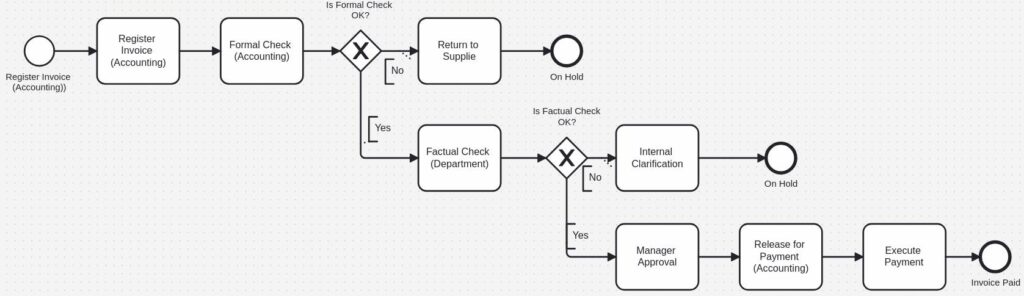
The process follows this structure:
- Accounting registers the invoice.
- Accounting performs the formal check.
- The process evaluates whether the formal check succeeded.
- If the check fails, accounting returns the invoice to the supplier.
- If the check succeeds, the responsible department performs the factual check.
- The process evaluates whether the factual check succeeded.
- If the check fails, the process starts an internal clarification.
- If the check succeeds, a manager approves the invoice.
- Accounting releases the invoice for payment.
- The organization executes the payment.
- The process ends when the invoice reaches the status “Invoice Paid.”
This description already shows why I call it a process rather than simply an algorithm. Different organizational responsibilities interact over time.
What the BPMN Model Shows
The BPMN model gives me information that an algorithm alone does not communicate as effectively.
First, I can see the sequence of work. Accounting registers the invoice and performs the formal check. After that, an exclusive gateway evaluates the result.
If the formal check fails, the process follows the “No” path. The invoice returns to the supplier, and this path ends with an “On Hold” status.
If the check succeeds, the “Yes” path continues to the factual check.
The responsible department now evaluates whether the invoice corresponds to the actual delivery or service. Again, an exclusive gateway controls the next step.
A failed factual check triggers internal clarification. A successful check leads to manager approval. Accounting can then release the invoice, and the organization can execute the payment.
The BPMN model makes the workflow, alternative paths, responsibilities, and business outcomes visible at the same time.
This is exactly where a process model provides value. It gives me an understandable view of the overall operation without forcing me to expose every technical rule behind every task.
Where Does the Algorithm Appear?
Now I can look at the same example from a different perspective.
Suppose I want software to control the routing of the invoice. I need more precise instructions. A statement such as “check the invoice” is no longer enough.
I could describe the routing logic with simplified pseudocode:
function processInvoice(invoice):

    registerInvoice(invoice)

    formalResult = performFormalCheck(invoice)

    if formalResult == false:
        returnToSupplier(invoice)
        setStatus(invoice, "on_hold")
        return

    factualResult = performFactualCheck(invoice)

    if factualResult == false:
        startInternalClarification(invoice)
        setStatus(invoice, "on_hold")
        return

    requestManagerApproval(invoice)

    releaseForPayment(invoice)
    executePayment(invoice)

    setStatus(invoice, "paid")
This representation looks similar to the process because I deliberately translated its routing logic into instructions. However, the perspective has changed.
The first instruction registers the invoice. The next instruction calls the formal check and stores its result.
The first conditional statement then asks a precise question: Did the formal check return false?
If it did, the algorithm invokes the action that returns the invoice to the supplier. It changes the status to “on hold” and stops the current execution. Therefore, none of the later instructions can run.
If the formal check returns true, execution continues to the factual check.
The second conditional statement follows the same principle. A failed factual check starts internal clarification and ends that execution path. A successful check allows the logic to continue toward approval and payment.
Finally, the instructions request manager approval, release the invoice for payment, execute the payment, and change the status to “paid.”
The algorithm converts the routing logic into explicit instructions that a software system can evaluate and execute.
However, this example also reveals an important limitation.
The pseudocode does not tell me which department owns the factual check. It does not explain organizational responsibilities particularly well. It also reduces activities such as manager approval to function calls, although the actual approval may depend on human judgment.
The BPMN model communicates these aspects much better.
The Algorithm Can Also Sit Inside a Process Task
There is another important distinction.
The previous pseudocode describes much of the routing logic of the process. However, algorithms often operate at a lower level.
Consider the BPMN task “Formal Check.”
The process model can keep that activity intentionally compact. Behind it, I could implement an algorithm such as:
function performFormalCheck(invoice):

    if invoice.invoiceNumber is missing:
        return false

    if invoice.supplier is missing:
        return false

    if invoice.invoiceDate is missing:
        return false

    if invoice.totalAmount <= 0:
        return false

    if invoice.requiredTaxInformation is missing:
        return false

    return true
Now the distinction becomes even clearer.
The process only needs to know whether the formal check succeeded. The algorithm defines how the system reaches that result.
For example, the algorithm first checks whether the invoice number exists. If not, it immediately returns false. The same happens when required supplier, date, amount, or tax information fails the defined validation rules.
Only when every condition succeeds does the algorithm return true.
The process can then use that result at the exclusive gateway:
- true means continue to the factual check;
- false means return the invoice to the supplier.
The BPMN task defines where the formal check belongs in the workflow, while the algorithm defines how that formal check works.
This separation becomes especially useful in automation.
Why I Do Not Put Every Algorithm into BPMN
I could add more and more conditions to the process diagram. However, that would usually make the model harder to understand.
For example, I could model separate gateways for the invoice number, tax information, supplier data, amount, and invoice date. Technically, that might work. Nevertheless, it would mix two abstraction levels.
Instead, I prefer to keep the process focused on meaningful business behavior.
“Formal Check” remains one business activity. Detailed validation rules belong behind that activity in an algorithm, decision table, business rule, or software component.
A good process model should expose the business logic that affects the workflow without reproducing every implementation detail.
The same principle applies to the factual check. The process needs to know whether the check succeeded. The exact method may depend on purchase orders, delivery records, tolerances, contract data, or other rules.
How Processes and Algorithms Work Together
I therefore do not treat process vs. algorithm as a choice between two competing approaches.
They operate at different levels.
The process orchestrates the work. It determines when activities occur, how participants interact, and which path follows a business decision.
Algorithms provide precise logic where the process needs calculation, validation, classification, or automated decision-making.
For example:
Process: Perform formal invoice check.
Algorithm: Verify that all mandatory invoice data meets defined rules.
Process: Decide whether the invoice can continue.
Algorithm: Return true or false based on the validation result.
Process: Obtain manager approval.
Algorithm: Determine which manager has sufficient approval authority based on the invoice amount.
Together, these elements can create an automated workflow without losing the business meaning behind it.
Process Automation Does Not Eliminate the Difference
Automation can make the boundary appear less obvious.
A process engine can execute a BPMN model. Software can perform individual tasks. Decision engines can evaluate rules. Services can execute algorithms automatically.
Nevertheless, I still distinguish their responsibilities.
A process engine coordinates the journey through the workflow. An algorithm solves a specific logical problem during that journey.
For example, an automated invoice process might call one algorithm to validate tax information, another to detect duplicate invoices, and another to determine the required approval level.
The process connects these capabilities into one business outcome: paying a valid invoice.
Automation combines processes and algorithms, but it does not make them the same concept.
Final Thoughts
When I compare process vs. algorithm, I focus on abstraction and purpose.
A process describes how work progresses across activities, decisions, people, and systems. An algorithm defines precise instructions for solving a particular problem.
Therefore, I use BPMN when I need to understand or communicate the workflow. I use algorithms when I need to specify detailed logic that can produce a predictable result.
Most importantly, I combine both when I design automation.
The process provides the structure of the work, while the algorithm provides the precise logic required inside that structure.
That distinction helps me create models that remain understandable for business stakeholders while still giving developers enough precision to implement reliable a
What’s Next
Now that I have separated processes from algorithms, I can return to the broader management view. A process alone does not improve work automatically. I need structure, responsibility, analysis, and continuous improvement to manage it well.
Read What is Process Management next. In that article, I explain how process management helps me plan, control, analyze, and improve business workflows. Therefore, you can see how single processes become part of a managed system. As a result, process management helps you create clearer work, better decisions, and stronger business results.
Management and Processes Connect Business Direction with Better Work
Read Management to see how I connect business direction, requirements, services, and processes in one clear overview. In the main article, I explore Management, Requirements Management in the IREB CPRE context, and Process Management in the BPMN context. Therefore, you can understand how these disciplines support better decisions and stronger results. As a result, management becomes a practical guide for building structure, value, and long-term success.
Read Processes to see how I connect process work, BPMN, and Camunda in one practical overview. In the main article, I explore Process Management, BPMN, and Camunda as a tool for BPMN modeling. Therefore, you can understand how processes become visible, structured, and easier to improve. As a result, processes become a practical foundation for analyzing workflows, modeling business behavior, and creating better operational decisions.
Credits: The diagrams were created with Camunda.