
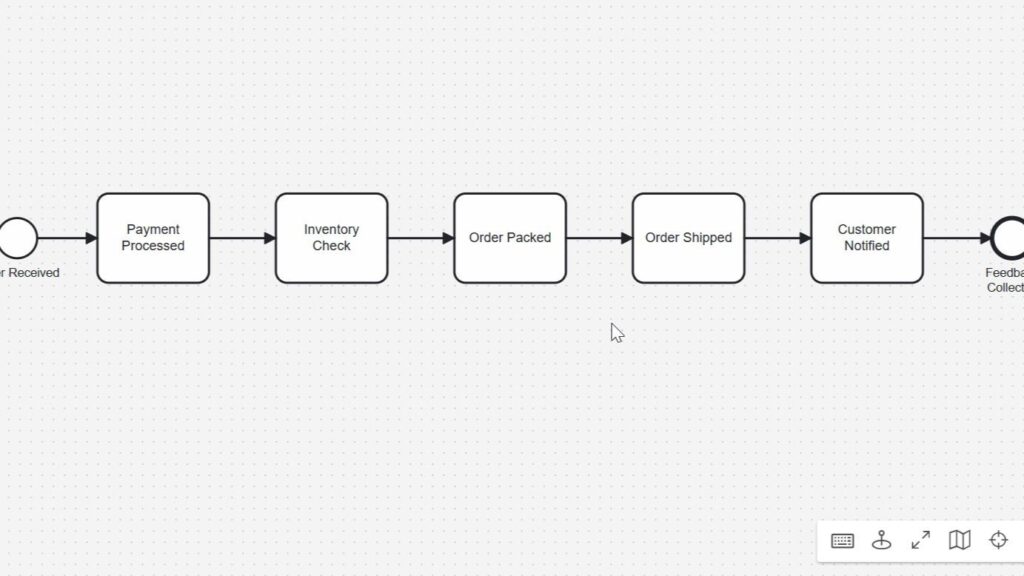
Business Process Management (BPM) makes processes transparent and helps businesses optimize and adjust them efficiently. When done right, BPM boosts productivity, reduces errors, and improves overall performance.
What is Process Management?
Process management focuses on defining, monitoring, and improving workflows. Every organization relies on structured processes to function smoothly. Without a clear approach, inefficiencies grow, errors increase, and teams struggle with inconsistencies.
By managing processes properly, businesses ensure tasks flow logically, responsibilities are clear, and objectives are met. This foundation allows for continuous improvement.
What is Business Process Management?
Business Process Management takes process management a step further. It aligns business goals with operational workflows, ensuring processes are efficient, scalable, and adaptable. BPM isn’t just about defining workflows; it’s about continuous improvement through analysis, automation, and monitoring.
BPM follows a structured approach:
- Analysis: Identify inefficiencies and bottlenecks.
- Modeling: Design the optimal process flow.
- Execution: Implement the process using tools or automation.
- Quality assurance: Monitor performance and ensure compliance.
- Optimization: Refine and improve the process over time.
A Simple Example: Order Processing
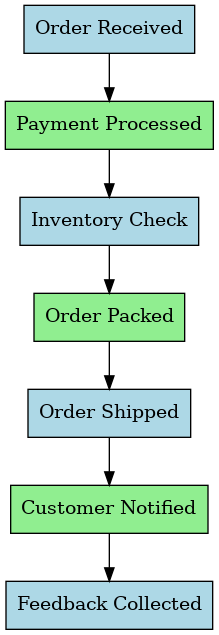
Let’s consider a business that processes customer orders. Without BPM, orders might get delayed, invoicing might be inconsistent, and tracking shipments could be chaotic. By implementing BPM, the company can streamline the workflow:
- Order Received → The system logs the customer’s order.
- Payment Processed → The finance team verifies and approves the payment.
- Inventory Check → The warehouse team confirms stock availability.
- Order Packed → The fulfillment team prepares the shipment.
- Order Shipped → The delivery team dispatches the package.
- Customer Notified → The system sends an update with tracking details.
- Feedback Collected → The company gathers insights to improve future orders.
In BPMN it would look like this:
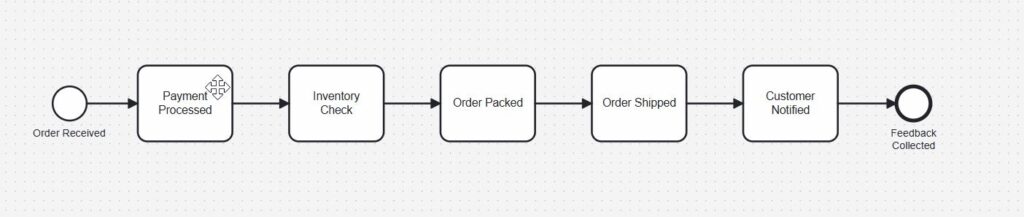
With BPM, the company gains transparency at every step. If a delay occurs, managers can pinpoint the issue and fix it quickly. Plus, automation can streamline many steps, reducing manual workload and human errors.
Final Thoughts
Business Process Management ensures processes run efficiently. By focusing on analysis, modeling, execution, quality assurance, and optimization, businesses can continuously improve operations. Whether automating tasks or identifying inefficiencies, BPM is essential for long-term success.