
In software development, I strive to model the real world effectively. One of my strongest tools is object orientation—it turns complex problems into clear, structured models. But first, we must ask: what defines an object? I focus on three key aspects—object name, status, and object behavior. These elements bring systems to life and make them understandable. In this article, I’ll share how I think about objects and use their behavior to design better, more realistic software systems.
What Defines an Object?
When I model a system with object-oriented concepts, I represent relevant entities as objects. An object combines data with operations that work with that data.
For example, I can represent a truck as an object. The object can store its current velocity and number of passengers. Moreover, it can provide operations for accelerating, braking, or adding a passenger.
I distinguish three closely related aspects:
- name and identity
- state
- behavior
An object keeps its identity even when its state changes.
That distinction becomes especially important when a system contains many similar objects.
Object Name and Identity
I use a name such as myTruck to refer to an object. The name makes a model or program easier to understand. However, I do not treat the name itself as the object’s identity.
In many programming languages, myTruck is a variable or reference that points to an object. Furthermore, two references can sometimes point to the same object. Therefore, object identity exists independently of the label I use to access the object.
For a simple conceptual model, however, names such as myTruck and yourTruck help me distinguish individual truck objects.
Two objects can contain exactly the same data and still have different identities.
This point becomes clearer when I look at their state.
State Describes an Object at a Specific Time
An object’s state consists of the current values of its relevant attributes.
Suppose myTruck has two attributes:
- velocity
- number of passengers
At one moment, the truck has a velocity of 100 and carries one passenger
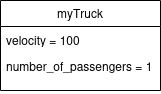
These values describe the current state of myTruck. They do not define the truck permanently. Instead, they represent the object at one particular moment.
State describes what is true about an object now, not what the object fundamentally is.
This distinction matters because state can change.
The Same Object Can Change Its State
Next, I reduce the truck’s velocity from 100 to 60. The number of passengers remains unchanged.
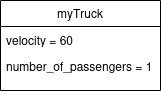
I still refer to the same myTruck object. Only one attribute value has changed.
This example illustrates an essential property of objects. Their state can evolve during their lifetime. For example, a truck can accelerate, stop, gain a passenger, or lose a passenger. Nevertheless, these changes do not create a new truck object.
Therefore, I separate identity from state.
Changing an object’s state does not normally change its identity.
This principle allows me to model entities that develop over time while remaining the same entities.
Different Objects Can Have the Same State
Now I add another object called yourTruck. Both trucks have a velocity of 60 and one passenger.
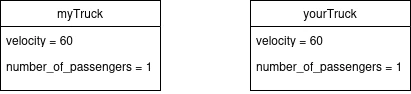
Their attribute values are identical. However, they still represent two different truck objects.
This distinction has practical consequences. For example, changing the velocity of myTruck should not automatically change the velocity of yourTruck. Each object maintains its own state unless I explicitly model shared data or another relationship between them.
Therefore, equal attribute values do not imply equal identity.
Objects with identical states can still represent completely separate instances.
This idea appears throughout object-oriented systems. Two customer objects may contain the same name and address. Two products may have the same price. Likewise, two vehicles may have identical technical properties. Their values may match, but the system can still treat them as distinct objects.
Behavior Defines What an Object Can Do
State tells me what an object currently looks like. Behavior tells me what the object can do.
I represent behavior through operations or methods. For a truck, useful operations could include:
- accelerate
- brake
- addPassenger
- removePassenger
An operation can inspect state, calculate a result, communicate with another object, or change state.
For example, addPassenger can increase the number of passengers. Similarly, brake can reduce the current velocity.
However, behavior does not always change state. An operation could simply return the truck’s current velocity or determine whether another passenger can enter.
Behavior defines the operations an object provides, while state records the values that may result from those operations.
This connection between state and behavior is one of the central ideas of object orientation.
Behavior Should Protect the Object’s State
I do not want every part of a system to change object data arbitrarily. Instead, I can let the object control how valid changes occur.
For example, a truck should not accept a negative number of passengers. Likewise, its passenger count should not exceed its capacity.
Therefore, an addPassenger operation can check these conditions before changing the state.
This approach supports encapsulation. The object combines its data with the rules that govern that data. As a result, I can protect important constraints and reduce unintended changes.
How Name, State, and Behavior Work Together
I use the three concepts for different purposes.
The name gives me a practical way to refer to an object. More precisely, the object has its own identity regardless of that name.
The state describes the object at a particular point in time.
The behavior defines the operations that the object can perform or provide.
Together, these concepts let me model individual entities that retain their identity, hold information, and participate in a changing system.
I therefore understand an object as an entity with its own identity, a current state, and defined behavior.
Final Thoughts
Object-oriented programming becomes much clearer when I keep identity, state, and behavior separate.
My truck example shows why. myTruck remains the same object when its velocity changes. At the same time, myTruck and yourTruck remain different objects even when all their attribute values match. Finally, operations such as accelerate or addPassenger provide controlled ways to work with that state.
This distinction gives me a solid foundation for object-oriented analysis, modeling, and programming. Instead of treating objects as simple containers for
What’s Next?!
Now that you understand how object behavior shapes realistic and effective software models, it’s time to see how these concepts come together in real-world projects. In my next article, “Leveraging Applications in Requirements Modeling,” I’ll show how to apply modeling principles to practical use cases. Discover how well-designed applications bridge the gap between requirements and implementation, turning ideas into working systems that deliver real business value.
Shape Better Software from the Start
Continue with Requirements Engineering to learn how unclear ideas become structured, realistic, and valuable software goals. It shows how strong requirements create clarity, bring stakeholders together, and support better decisions from the beginning. As a result, you can see how requirements engineering helps teams move from uncertainty to purposeful software solutions.
If I want to go one step further, I continue with Requirements Modeling. There, I explore Modeling Concepts, Process Modeling with BPMN, and UML to understand how models make requirements easier to visualize, structure, and communicate. Together, these topics help me connect business needs, processes, and system design in a clearer and more practical way.
Credits: The diagrams were created with draw.io.