
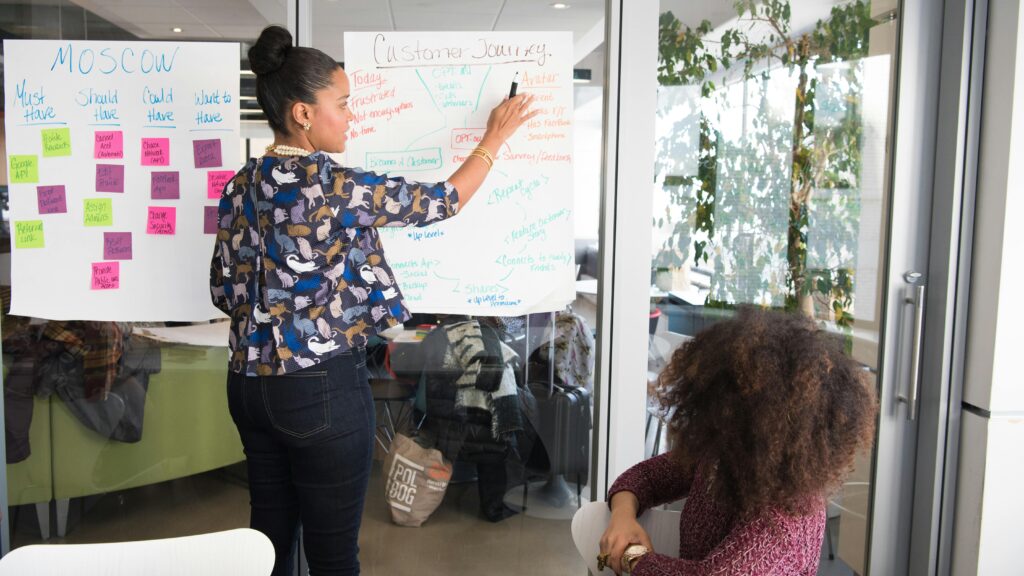
As a Requirements Engineer and IT Business Analyst, I must explain stakeholder needs clearly to clients, developers, and managers. When one project exceeded its budget, I learned how much presentation skills matter in difficult situations. Present as a Requirements Engineer helps me structure messages, stay confident, and guide discussions. Therefore, I can share requirements clearly and support better project decisions.
I Start with the Purpose
Before I prepare slides, I define what I want to achieve.
For example, I may want stakeholders to:
- approve a requirement,
- select between solution options,
- understand a project risk,
- clarify a business rule,
- resolve conflicting expectations,
- or agree on the next step.
This purpose determines the structure of my presentation.
If I cannot explain what decision or outcome I expect, I am not ready to present.
Therefore, I avoid starting with slides. Instead, I first define the message.
I Adapt the Message to the Audience
Different audiences need different information.
A developer may want detailed acceptance criteria, dependencies, and edge cases. A manager may care more about cost, risk, scope, and delivery impact. Meanwhile, a business stakeholder may want to understand how a requirement improves a process or solves a specific problem.
Therefore, I do not present the same information in the same way to everyone.
I ask myself:
What does this audience already know?
What do they need to understand?
What decision must they make?
Which details could distract them?
I keep the underlying facts consistent, but I adapt the level of detail and explanation to the audience.
I Build a Clear Story
Requirements presentations often become difficult because they contain too much disconnected information.
Therefore, I use a simple structure:
- Context
- Problem
- Relevant facts
- Requirements or options
- Consequences
- Recommendation
- Decision or next step
This sequence gives the audience a reason to follow the presentation.
For example, I do not begin with twenty requirements. Instead, I explain the business problem first. Then I show which requirements address it.
As a result, individual requirements become part of a coherent solution rather than isolated statements.
I Focus on Decisions, Not Documentation
Requirements engineering produces many artifacts. However, a presentation should not reproduce them all.
A specification can contain dozens of pages. A process model can include many branches. A backlog may contain hundreds of items.
Therefore, I select only the information that supports the purpose of the meeting.
I use the presentation to guide the discussion and use detailed documentation as supporting material.
For example, I may show one important section of a BPMN process instead of the complete model. Likewise, I may present three critical requirements while keeping the full specification available for reference.
This keeps the discussion focused.
I Make Complexity Visible
Visual models are especially valuable in requirements engineering.
For example, I use:
- process models for workflows,
- context diagrams for system boundaries,
- simple tables for comparisons,
- state models for behavior,
- prototypes for user interactions,
- and diagrams for dependencies.
However, a diagram only helps when the audience can understand it quickly.
Therefore, I remove unnecessary elements and highlight the relevant part.
I use models to reduce complexity, not to demonstrate how much complexity I can model.
In addition, I explain the meaning of the model before discussing individual details.
I Separate Facts, Assumptions, and Decisions
Many project discussions become confusing because participants mix different types of information.
Therefore, I clearly distinguish between:
- confirmed facts,
- stakeholder needs,
- assumptions,
- open questions,
- proposed solutions,
- and agreed decisions.
For example, I may say:
“The current process requires manual approval. That is a fact.”
“We assume that automated approval would reduce processing time. We still need to validate that assumption.”
This distinction improves discussions significantly.
When I clearly separate evidence from assumptions, stakeholders can challenge the right things.
I Explain the Reason Behind Requirements
A requirement becomes easier to understand when people know why it exists.
Therefore, I do not only explain what the system must do. I also explain the underlying need.
For example:
“The system must validate the customer number before submission.”
Then I add the reason:
“This prevents incomplete requests from entering the downstream process.”
The requirement now has context.
Moreover, this approach helps when stakeholders challenge the requirement. Instead of defending a sentence in a specification, I can discuss the actual business need.
I Prepare for Questions and Objections
Good requirements presentations rarely end without questions.
Therefore, I prepare for them.
Before the meeting, I identify likely concerns. These may involve cost, usability, technical feasibility, compliance, dependencies, or scope.
I also check where my information remains uncertain.
I do not need an immediate answer to every question. However, I need to distinguish clearly between what I know and what I still need to investigate.
If I do not know something, I state that directly. Then I define how I will clarify it.
This creates more trust than an uncertain answer presented as a fact.
I Keep Slides Simple
Slides support my explanation. They do not replace it.
Therefore, I avoid long paragraphs and overloaded diagrams.
Instead, I use one main message per slide whenever possible.
I also prefer descriptive slide titles.
For example, instead of writing:
“Current Process”
I might write:
“Manual approval creates a two-day delay.”
The second title immediately communicates the important point.
A stakeholder should understand the main message of a slide before I explain the details.
I Practice the Explanation, Not the Script
Preparation matters. However, memorizing every sentence can make a presentation rigid.
Therefore, I practice the logic of the presentation.
I make sure that I can explain:
- why the topic matters,
- how the information connects,
- which points require discussion,
- and what decision I need.
This allows me to speak naturally while keeping the presentation structured.
In addition, I practice difficult transitions and complex explanations. These are usually more important than memorizing an introduction.
I Learn from Every Presentation
Presentation skills improve through repetition and reflection.
Therefore, after an important meeting, I review what happened.
I ask myself:
Did stakeholders understand the problem?
Did the discussion stay focused?
Which questions surprised me?
Where did I explain too much?
Where did I provide too little context?
Did the meeting produce the required decision?
I also study strong speakers and presentations. However, I do not simply copy presentation styles. Instead, I analyze why a particular explanation worked.
For example, I look at structure, pacing, visual support, transitions, and argumentation.
Then I test useful techniques in my own work.
Conclusion
Presenting effectively as a Requirements Engineer means turning analysis into understanding and understanding into decisions.
Therefore, I focus on the purpose of the presentation, the needs of the audience, and the decision that must follow. I simplify complex information without removing important details. I use models when they improve understanding. In addition, I distinguish facts from assumptions and explain the reasons behind important requirements.
My goal is not to impress stakeholders with documentation. My goal is to help them understand the situation well enough to make a sound decision.
That makes presentation skills an important part of professional requirements engineering.
What’s Next?!
Presenting effectively helps me explain requirements with clarity and confidence. However, facts alone do not always create understanding. I also need stories that connect ideas, context, and stakeholder needs.
Therefore, I continue with The Power of Storytelling in Requirements Engineering. In the next article, I explore how storytelling helps me make requirements easier to understand, remember, and discuss. As a result, I can communicate complex ideas more clearly and guide stakeholders toward better decisions.
Grow Through Personal Growth
Read Personal Growth to see how I connect self-understanding, change, habits, discipline, decisions, stress, personality, cognition, and openness in one practical overview. In this main article, I also show how personal growth strengthens stakeholder management, elicitation, body language, presentation, storytelling, repartee, negotiation, and effective communication. Therefore, I can present ideas more clearly, tell better stories, and become a stronger requirements engineer.
Credits: Photo by Christina Morillo from Pexels